




More Than a Test Flight
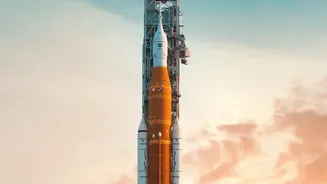
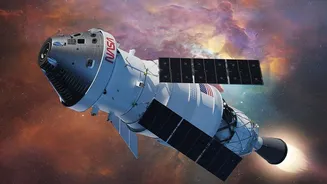
While Artemis II's primary objective was to be the first crewed flight test of the powerful Space Launch System rocket and the Orion spacecraft, it was always designed as a dual-purpose mission. Beyond proving the hardware could safely carry astronauts
on a 10-day journey around the Moon, the flight was a critical opportunity for science. Every moment, from launch to splashdown, was a chance to collect information that no robot or uncrewed probe could provide. Teams are now meticulously analyzing terabytes of data that will directly inform how NASA executes Artemis III—the mission slated to land the first woman and next man on the Moon—and builds a sustainable presence for future journeys to Mars.
The Unseen Threat of Radiation
One of the most significant dangers for astronauts traveling beyond low Earth orbit is deep space radiation. Outside the protection of Earth's magnetic field, the crew of Artemis II was exposed to a constant barrage of galactic cosmic rays. The Orion capsule was outfitted with sensors, and the crew wore specialized monitors to provide the first real-world data on radiation exposure for a mission of this type in the modern era. Early analysis is helping scientists validate their predictive models. This work is essential for confirming the effectiveness of Orion's shielding and the emergency procedures for sheltering during a solar storm. Understanding this radiation environment is not just academic; it is fundamental to designing the habitats, rovers, and spacesuits that will keep future lunar explorers safe.
Testing Humanity’s Life Support
Artemis II was a thorough examination of the human element of spaceflight. For over a week, four astronauts lived and worked inside the Orion capsule, putting its advanced life support systems to the test. Researchers are now studying the performance of the systems that provided breathable air, managed temperature and humidity, and processed waste. Beyond the hardware, scientists are poring over a wealth of data on the astronauts themselves. Using wearable sensors, journals, and pre- and post-flight medical exams, they are building a detailed picture of how deep space affects the human body and mind. Data on sleep patterns, stress levels, cognitive performance, and immune system changes will help NASA refine protocols to ensure crew health and peak performance on missions that will last much longer.
Communicating at the Speed of Light
The mission successfully demonstrated a game-changing technology: laser communications. The Orion Artemis II Optical Communications System, or O2O, used infrared lasers to transmit data back to Earth at rates up to 260 megabits per second. This is a massive leap from the radio-frequency systems used during the Apollo era. The O2O system enabled the crew to send high-definition 4K video from lunar orbit, providing stunning live views of 'Earthrise' and the far side of the Moon. More importantly, it proved that this technology is viable for supporting complex missions at vast distances. The ability to quickly send large packets of scientific data, high-resolution imagery, and telemetry will be indispensable for operations on the lunar surface and eventual missions to Mars.
The View from a Human Eye
While sensors and systems collected invaluable quantitative data, NASA also tasked the crew with being human observers. Astronauts Reid Wiseman, Victor Glover, Christina Koch, and Jeremy Hansen were trained to document geological features, look for evidence of water ice in shadowed craters, and note any unexplained phenomena like meteoroid impacts or the faint 'horizon glow' caused by electrostatically lifted dust. This human perspective provides context that robotic missions can miss. The crew's detailed notes, photographs, and debriefings are now being integrated with instrumental data, creating a richer, more complete understanding of the lunar environment that will guide future explorers on the ground.