



Meet the Telescope That Doesn't Move
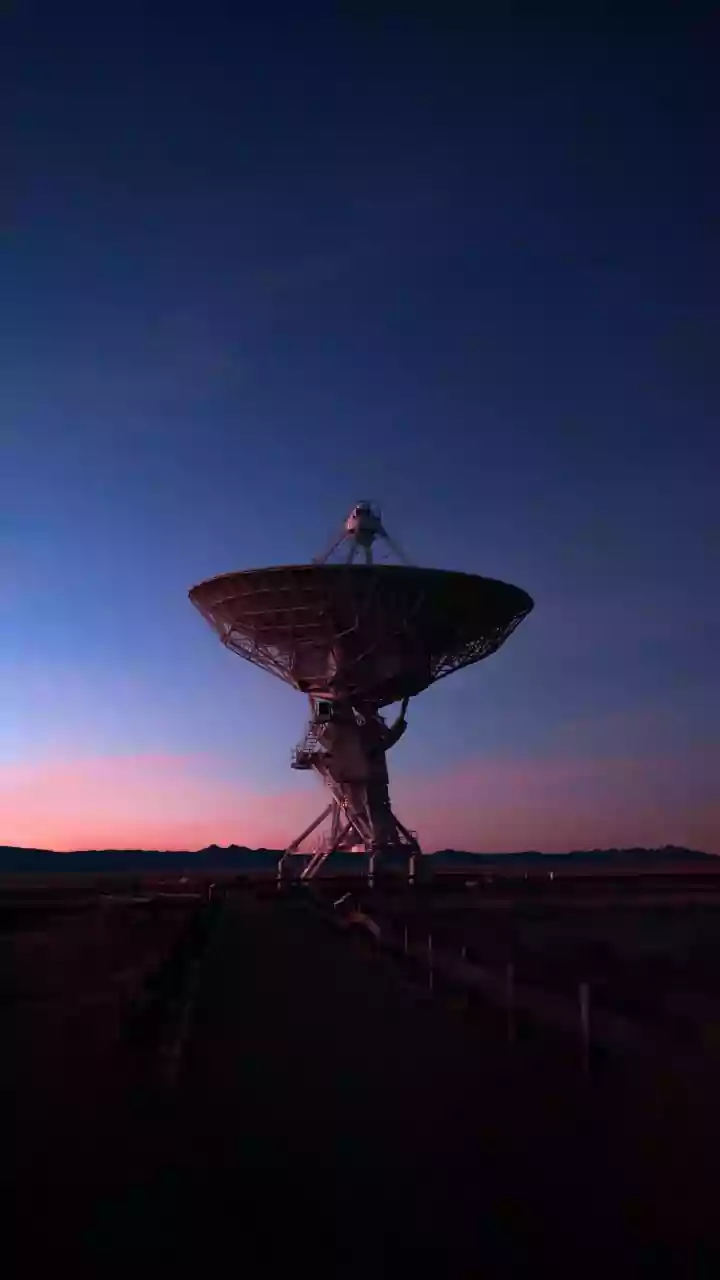
In the hills of British Columbia, Canada, sits a telescope that looks more like a set of massive skateboarding half-pipes than a conventional observatory. This is the Canadian Hydrogen Intensity Mapping Experiment, or CHIME. Unlike dish telescopes that pivot
to track stars, CHIME is stationary. It's made of four large, curved reflectors of wire mesh that collect faint radio signals from space as the Earth turns, scanning the entire Northern sky every single day. Its unique design and immense sensitivity make it a perfect instrument for detecting some of the most elusive signals in the cosmos.
A Whisper From 8 Billion Years Ago
The signal that has astronomers so excited is a specific type of radio wave known as the '21-centimetre line'. It's emitted by neutral hydrogen atoms, the most common element in the universe. This emission happens when the spin of an electron flips relative to its proton, releasing a tiny burst of energy at a precise frequency. Because this radiation can travel vast cosmic distances and pass through dust clouds that block visible light, it acts as a perfect tracer. The signal CHIME detected was emitted when the universe was only about five billion years old, meaning the light travelled for roughly eight to nine billion years to reach us.
The Dark Energy Connection
So, how does old hydrogen help us understand dark energy? In the 1990s, astronomers discovered that the universe's expansion is speeding up, not slowing down as gravity would suggest. The unknown force driving this acceleration was named dark energy, and it remains one of the biggest puzzles in physics. By mapping the distribution of hydrogen across the sky and through time, CHIME can create a massive 3D map of the universe's structure. This map reveals something called Baryon Acoustic Oscillations (BAO), which are gigantic, spherical patterns of matter left over from the early universe. These patterns serve as a 'standard ruler' to measure how fast the universe was expanding at different points in its history, which in turn helps scientists test theories about what dark energy is and how it behaves.
Why Ninety-Four Nights Matter
The breakthrough comes from analysing data collected over 94 nights in 2019. For the first time, CHIME has been able to detect this hydrogen signal on its own, without needing to cross-reference its data with other, more expensive galaxy surveys. This is a huge milestone, proving the 'intensity mapping' technique works independently. The challenge was immense: the hydrogen signal is incredibly faint and buried under radio noise from our own galaxy, human technology, and even the telescope itself. After more than a year of rigorous testing to ensure it wasn't a false alarm, the team confirmed the signal was real, achieving a statistical significance of 12.4 sigma—far beyond the threshold for a confirmed discovery.