







Meet the Pink Planet
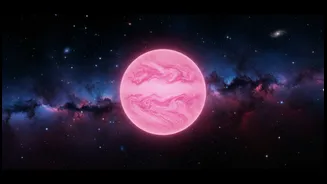
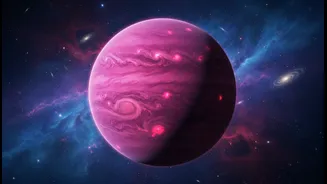
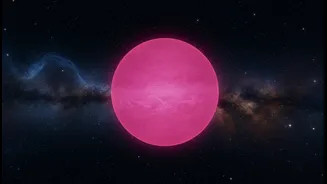
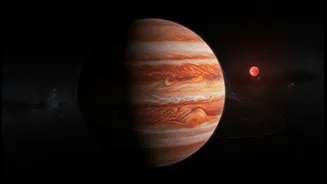
Discovered in 2013 by astronomers using the Subaru Telescope in Hawaii, GJ 504 b is a gas giant exoplanet located about 57 light-years away in the constellation Virgo. What immediately set it apart was its stunning color, described by NASA as reminiscent
of a dark cherry blossom or a dull magenta. This isn't just an artist's impression; the planet's color is a direct result of its physical properties. It is several times more massive than Jupiter, our solar system's own giant. Its discovery was a landmark moment, as it was the lowest-mass planet to be directly imaged orbiting a star similar to our sun at the time.
Why the Rosy Glow?
The planet's striking pinkish hue is not due to a cosmic paint job but is a result of its youth and intense heat. GJ 504 b is still glowing with the residual heat from its formation. With an effective temperature of around 290 degrees Celsius (about 555 Fahrenheit), it's incredibly hot by Earthly standards, comparable to the inside of a working oven. This heat causes the planet itself to glow. Because its atmosphere is believed to have fewer clouds than other similar planets, this internal, infrared glow is more visible, giving it a distinctive magenta color in the eyes of infrared telescopes. However, some recent analysis suggests that if a human were to see it up close, its color might appear more blue or brown, as our eyes cannot perceive infrared light.
A Puzzle for Planet Formation
Beyond its pretty face, GJ 504 b poses a significant challenge to astronomers' understanding of how giant planets are born. The most widely accepted theory, known as core accretion, works well for planets that form relatively close to their star, like Jupiter and Saturn. This model suggests that a rocky core forms first, and its gravity then pulls in vast amounts of surrounding gas to create a giant planet. However, GJ 504 b orbits its star at a projected distance of about 44 times the distance between Earth and our sun—far wider than Neptune's orbit in our own system. At such a great distance, the core accretion model struggles to explain how a core could have formed quickly enough to gather such a massive gassy envelope. This makes GJ 504 b a fascinating anomaly that forces scientists to rethink their models.
New Insights from James Webb
For years, the planet remained a beautiful enigma. More recently, the James Webb Space Telescope (JWST) has turned its powerful gaze towards this distant world, peeling back new layers of the mystery. In observations announced in mid-2026, astronomers detected an atmosphere shrouded in dense clouds of metallic salt, a feature not clearly observed before on such a cool and distant object. Analysis of the light spectrum also revealed the presence of water vapor, methane, and carbon dioxide. These findings, made possible by Webb's incredible sensitivity, are helping to refine estimates of the planet's age and mass, though the debate continues on whether it is a very large planet or a small brown dwarf—a kind of 'failed star'.