









When the Path Becomes the Problem
Think of a time you followed a poorly planned route. Maybe it was a tourist trail that funneled you through souvenir shops while bypassing authentic local culture, or a city sidewalk that forced an awkward, circuitous path around a block for no apparent
reason. In these moments, the journey becomes a battle. The route, instead of being a gentle guide, becomes an obstacle to overcome. Landscape architects and urban planners have a term for the unofficial dirt paths that appear in parks where paved walkways are inefficient: 'desire paths'. These trails, worn into the earth by countless footsteps, are a quiet rebellion against prescribed routes. They are physical proof that people instinctively seek the most logical or pleasant way forward, even when designers have dictated otherwise. When a route ignores human nature—our desire for efficiency, beauty, or a moment of peace—it fails. It creates friction, turning a potential experience into a mere task of transit.
The Art of the Intentional Journey
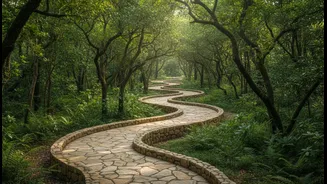
Now, consider the opposite: a route designed with purpose and feeling. Ancient pilgrimage trails like the Camino de Santiago in Spain or the Kumano Kodo in Japan are masterful examples. These paths are not just about getting from a starting point to a sacred shrine; they are engineered for reflection. The climbs, the descents, the long, meditative stretches through nature—every element is part of a larger emotional and spiritual architecture. The route itself is a key part of the pilgrimage. Similarly, celebrated scenic drives like the Blue Ridge Parkway in the United States were not designed for speed. Their flowing, serpentine curves were intentionally crafted to reveal vistas slowly, to harmonize with the landscape, and to make the act of driving a form of pleasure and discovery. The designers understood that the purpose was not just to connect two points, but to create an unforgettable experience along the way.
Listening to Our Footsteps
Desire paths do more than just highlight our impatience with inefficient design; they reveal a deeper truth about human behavior. They are a form of feedback, written on the landscape with our feet. They show where a design failed to anticipate a need, whether for a shortcut, a safer crossing, or a more intuitive connection between two points. Some forward-thinking planners have even begun to use this phenomenon as a design tool. Instead of paving walkways based on an architectural blueprint, they wait to see where desire paths naturally form and then pave those routes. This approach acknowledges a simple but profound idea: the people who use a space often understand its needs better than those who design it. It's a shift from dictating movement to facilitating it, from imposing a plan to responding to collective wisdom.
Finding a Better Path in Daily Life
This philosophy extends far beyond hiking trails and city parks. It’s a principle you can apply to almost any aspect of life. Is your daily commute a stressful battle against traffic, or could a slightly longer, more scenic route through a quiet neighborhood improve your morning? When planning a project, do you chart the most direct, aggressive path to completion, or do you build in time for thoughtful detours and creative exploration? A route that serves the experience values the journey itself. It recognizes that how we arrive at a destination shapes our perception of it. By consciously choosing our paths—whether it's the road we drive, the trail we walk, or the strategy we employ—we can transform mundane tasks into meaningful experiences. A well-designed route doesn't just lead you to a place; it enhances your presence within it.