





The 'Puffy' Shield Solution
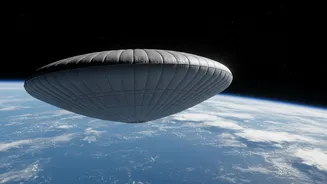
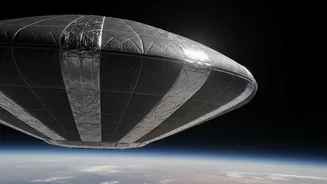
At first glance, it sounds like science fiction: a heat shield that inflates like a balloon. But the Hypersonic Inflatable Aerodynamic Decelerator, or HIAD, is a very real and promising technology. Instead of a heavy, solid cone, a HIAD consists of a series
of concentric rings woven from advanced polymers that are stronger than steel by weight. These rings are packed tightly for launch and then inflated in space, creating a large, stable, and surprisingly durable shield. The outer surface is covered with a flexible thermal protection system, typically a ceramic-fibre cloth, capable of withstanding the scorching temperatures of atmospheric re-entry, which can reach thousands of degrees. This design is a game-changer because it solves a fundamental problem: the size of the rocket.
Bigger, Lighter, and Better
Traditional rigid heat shields are limited by the width of the rocket's payload fairing, the nose cone that protects the cargo during launch. This limits the size and weight of what we can land on other worlds. Inflatable shields bypass this constraint entirely. By launching in a compressed state, they can be deployed to a diameter much larger than any rigid shield could be. This larger surface area is incredibly effective at creating atmospheric drag, acting like a massive brake high in the planet's upper atmosphere where the air is thin. This allows the spacecraft to slow down more gradually and at higher altitudes, reducing the intense heat and forces experienced during the final descent. The ultimate goal is to enable the landing of much heavier payloads, such as human habitats, large rovers, and ascent vehicles for future missions to Mars.
Trial by Fire: The Ultimate Test
The most crucial test for an inflatable heat shield is, of course, a real-world demonstration. NASA's Low-Earth Orbit Flight Test of an Inflatable Decelerator (LOFTID) mission was a landmark success in this area. Launched as a secondary payload, the packed LOFTID vehicle was deployed in space, where it inflated to its full six-metre diameter. The vehicle was then intentionally sent on a re-entry course back to Earth, hitting the atmosphere at more than 28,000 kilometres per hour. Onboard sensors collected a torrent of data on temperature, pressure, and structural stability. The test was a resounding success, with LOFTID surviving the intense journey and splashing down gently in the Pacific Ocean for recovery. The data proved that the inflatable structure and its thermal layers could protect the payload, validating over a decade of development.
The Gauntlet on the Ground
Long before a heat shield ever reaches a launchpad, it endures a battery of brutal tests on Earth. Engineers must ensure the materials can withstand both the stress of being tightly folded and the extreme environment of re-entry. This involves rigorous ground testing. Prototypes are subjected to structural load tests to see how they handle aerodynamic forces. They are placed in enormous wind tunnels to study their flight stability and pressure distribution at hypersonic speeds. Perhaps most dramatically, material samples are blasted in arc jets, which use powerful electrical arcs to create plasma streams that simulate the searing heat of atmospheric entry. Agencies also perform extensive packing and deployment tests, repeatedly folding and unfolding the material to check for damage or leaks, ensuring it will work flawlessly when it matters most.
Opening New Worlds
Successfully testing this technology is not just an engineering exercise; it unlocks the next generation of space exploration. With proven inflatable decelerators, agencies can plan more ambitious missions. This includes landing scientific laboratories on Mars at higher-altitude locations that are currently inaccessible because the thinner atmosphere offers less braking friction for traditional landers. The technology is also being considered for probes to Venus and Saturn's moon Titan, both of which have thick atmospheres. Furthermore, this innovation has applications closer to home, such as enabling the cost-effective return of large payloads, rocket stages, and in-space manufactured goods from Earth orbit. For India's own ambitions in planetary exploration and reusable launch systems, technologies like HIAD represent a key area of global innovation to watch.