



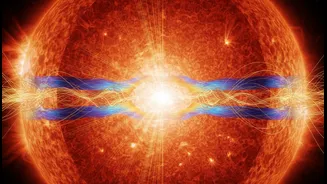


The Sun's Restless Surface
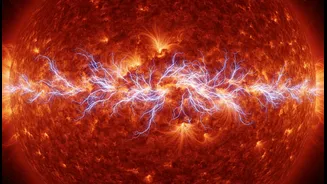
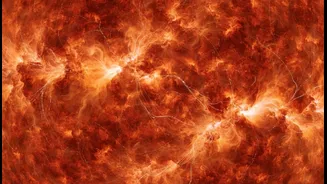
From our vantage point on Earth, the Sun can appear as a constant, unchanging star. In reality, its surface is a cauldron of magnetic chaos. We see this activity in the form of sunspots, which are temporary dark patches cooler than their surroundings,
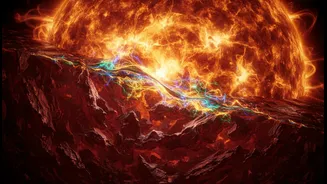
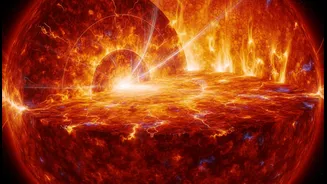
and spectacular eruptions like solar flares and coronal mass ejections (CMEs). These events are not just cosmic fireworks; they are the primary components of "space weather." When directed at Earth, these outbursts of radiation and plasma can disrupt satellite communications, damage power grids, and pose a risk to astronauts. For decades, scientists have sought to improve their forecasts of this activity, and the answer, it turns out, lies far beneath the fiery surface.
A Hidden Engine Room: The Tachocline
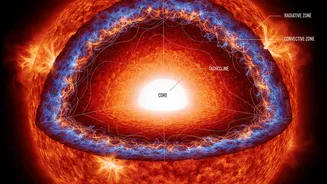
Deep inside the Sun, about 200,000 kilometres below the surface, lies a crucial boundary layer called the tachocline. First proposed in 1992, its existence has been confirmed through helioseismology, the study of the Sun's interior by observing vibrations on its surface. This layer is surprisingly thin, measuring less than 5% of the Sun's radius. It separates two distinct zones of the solar interior: the rigidly rotating radiative zone below and the turbulent, differentially rotating convection zone above. The significance of this thin layer far outweighs its size; it is now widely considered the place where the Sun's powerful magnetic field is born.
A Tale of Two Rotations
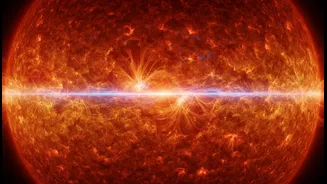
To understand why the tachocline is so important, we have to look at how the Sun spins. The inner part, the radiative zone, rotates like a solid ball. However, the outer layer, the convection zone, does not. It exhibits what is called differential rotation: the plasma at the equator spins much faster (about a 25-day period) than the plasma at the poles (about a 36-day period). The tachocline is the intense shear layer where these two dramatically different rotation styles meet. This creates an immense stretching and shearing of the superheated, electrically charged gas, known as plasma. It is this intense mechanical action that provides the perfect conditions for a magnetic dynamo.
Forging a Magnetic Field
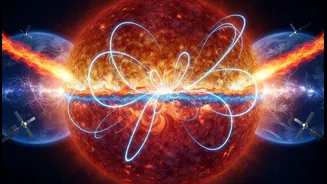
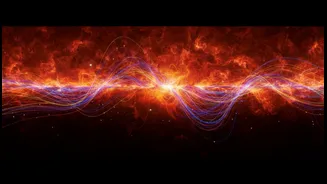
The process that generates the Sun's magnetism is known as the solar dynamo. Think of it as a naturally occurring electric generator. Dynamo theory explains that a rotating, convecting, and electrically conducting fluid can create and sustain a magnetic field. In the tachocline, the differential rotation takes the Sun's existing north-south magnetic field lines (the poloidal field) and stretches and winds them around the Sun, much like twisting a rubber band. This process dramatically amplifies the field, creating incredibly strong, rope-like magnetic structures that run east-west (the toroidal field). This is where the raw power for all subsequent solar activity is stored.
From Deep Interior to Surface Eruptions
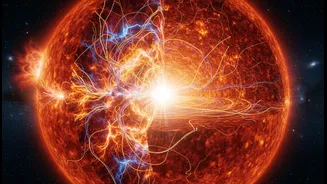
These powerful magnetic field ropes, generated and stored in the tachocline, are buoyant. Over time, they rise through the 200,000-kilometre-thick convection zone. As they ascend, the Sun's rotation adds further twists, creating complex loops. When these loops become strong enough, they breach the Sun's visible surface, the photosphere. Where they emerge, they create pairs of sunspots with opposite magnetic polarities. The tangling, crossing, and snapping of these magnetic field lines above the sunspots is what releases the enormous energy we see as solar flares and CMEs. Therefore, the activity we observe on the surface is a direct manifestation of the dynamo process occurring in the hidden tachocline below.
Why Better Physics Leads to Better Forecasts
Current space weather forecasts often provide only a few hours to a day of warning for potentially damaging events. The models used for these predictions are largely based on observing the Sun's surface. However, by incorporating a more detailed understanding of the tachocline's physics—how it shears plasma, builds magnetic fields, and how those fields are transported—scientists can create more accurate and longer-range forecasts. If we can better model the engine, we can better predict what the machine will do. This means moving from reactive forecasting based on surface features to predictive forecasting based on the fundamental physics of the solar dynamo. Improved models could one day give us several days of warning, providing critical time to protect our technological infrastructure on Earth and in space.