



A Science of One Data Point
Before the 1990s, astrobiology was a field rich in imagination but starved of data. The study of life in the universe had only one example to work with: life on Earth. Scientists could theorise about what other life might look like and where it could exist,
but they had no other worlds to study. Much of the field was dominated by concepts like the Drake Equation, a probabilistic argument to estimate the number of active, communicative extraterrestrial civilizations in the Milky Way, and the Search for Extraterrestrial Intelligence (SETI), which scans the skies for radio signals. While fascinating, these pursuits were fundamentally speculative. Without knowing if other planets were common or exceedingly rare, the search for life remained a hypothetical exercise.
The Discovery That Changed Everything
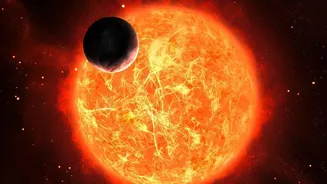
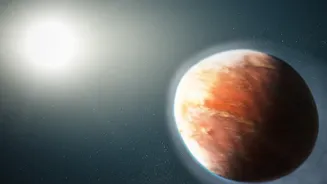
The paradigm shifted dramatically on October 6, 1995. Astronomers Michel Mayor and Didier Queloz announced the discovery of 51 Pegasi b, the first confirmed planet orbiting a star like our Sun. This wasn't just another celestial object; it was concrete proof that planets exist outside our solar system. The planet itself was a bizarre world, a gas giant larger than Jupiter orbiting its star in a mere four days—a type of planet now dubbed a 'hot Jupiter'. Its existence challenged the then-current models of planet formation, which were based solely on our own solar system. More importantly, it opened the floodgates. The detection of 51 Pegasi b proved that we had the technology to find these distant worlds, turning the search for exoplanets from a dream into a tangible scientific pursuit.
From a Trickle to a Flood
Following the discovery of 51 Pegasi b, the field of exoplanet hunting exploded. The real game-changer was NASA's Kepler Space Telescope, launched in 2009. Designed specifically to hunt for planets, Kepler stared at a single patch of sky for years, watching for the tiny, periodic dips in starlight caused by a planet passing in front of its star. The mission was a wild success, discovering thousands of confirmed exoplanets and revealing that our galaxy is teeming with them. In fact, Kepler's data suggests there are more planets than stars in the Milky Way. Its successor, the Transiting Exoplanet Survey Satellite (TESS), continues this work by scanning the entire sky for nearby planets. This deluge of data provided astrobiology with the statistical foundation it had always lacked.
Asking New, Testable Questions
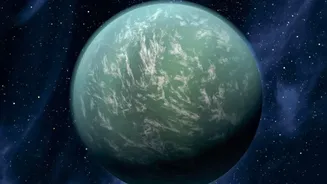
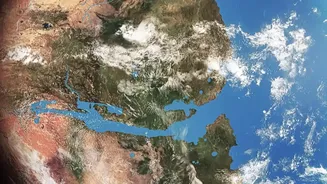
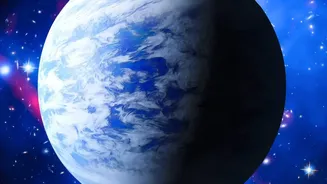
With a catalogue of thousands of worlds, scientists could finally move from 'if' to 'where' and 'how'. The conversation shifted from the philosophical possibility of other planets to the statistical reality. Astronomers can now ask specific, data-driven questions: What is the most common type of planet? (It turns out to be worlds between the size of Earth and Neptune, a category not even present in our solar system). How many planets orbit within their star's 'habitable zone', the region where liquid water could potentially exist on the surface? The sheer diversity of planetary systems discovered has forced a complete re-evaluation of how planets form and evolve. Astrobiology was no longer just about searching for signals; it was about identifying the most promising targets for a deeper look.
The Era of Characterisation with JWST
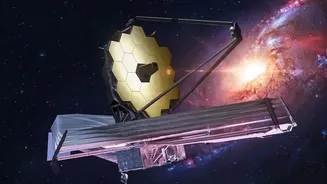
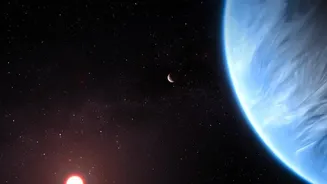
Today, the field is entering its most exciting phase yet, thanks to the James Webb Space Telescope (JWST). JWST is not primarily a planet-finder; it's a planet-characteriser. Its powerful infrared instruments allow scientists to do something truly remarkable: analyse the chemical makeup of an exoplanet's atmosphere. By capturing the starlight that filters through a planet's air, the telescope can detect the spectral fingerprints of different molecules like water, methane, and carbon dioxide. This is the heart of modern astrobiology—the search for 'biosignatures', combinations of gases that could indicate the presence of biological processes. While detecting life remains an immense challenge, JWST is providing the first real opportunity to inventory the ingredients for life on worlds light-years away.