





Gaganyaan: India's Leap into Human Spaceflight
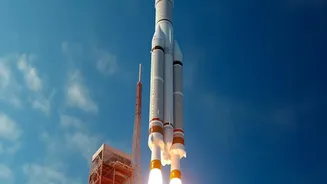
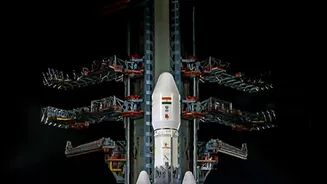
The Gaganyaan mission is arguably ISRO's most awaited project. The goal is to send a crew of three Indian astronauts into a 400-kilometre orbit for three days and bring them back safely. This would make India only the fourth nation in the world to achieve
independent human spaceflight capability. The mission is not just about prestige; it's a massive technological undertaking that will drive innovation in life support systems, crew escape mechanisms, and human-rated launch vehicles. After a series of uncrewed test flights, with the first (G1) anticipated in late 2026 or early 2027, the first crewed flight could follow, marking a monumental moment for the nation.
Bharatiya Antariksha Station: A Home in the Sky
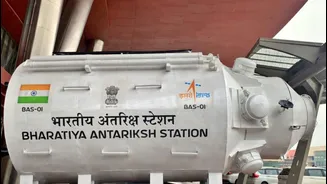
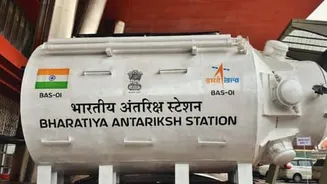
What comes after sending humans to orbit? Giving them a place to stay. The Bharatiya Antariksha Station (BAS) is India's answer to the International Space Station. Envisioned as a modular 52-tonne outpost, it will orbit at an altitude of about 400 km. The plan is to launch the first module by 2028, with the station expected to be fully operational by 2035. The BAS will serve as a microgravity laboratory for cutting-edge research in science and medicine, and a crucial training ground for even longer-duration missions, such as a future trip to the Moon.
Mangalyaan-2: A Bolder Return to Mars
After the trailblazing success of the first Mars Orbiter Mission (MOM), Mangalyaan-2 is set to be a far more ambitious follow-up. While the first mission was an orbiter that proved India's capability to reach Mars on the first attempt, the next iteration is expected to be more complex. Current plans suggest a mission that could include not just a more powerful orbiter with advanced scientific instruments like a hyperspectral camera and radar, but potentially a lander and a rover. Tentatively scheduled for launch no earlier than 2026, this mission aims to conduct in-depth studies of the Martian surface, atmosphere, and geology, possibly even deploying a helicopter for aerial exploration.
Shukrayaan-1: Unveiling the Secrets of Venus
Often called Earth's 'twin' due to its similar size, Venus is a hostile world with a thick, toxic atmosphere. ISRO's Shukrayaan-1 mission aims to peek under this cloudy veil. This will be India's first mission to Venus, placing an orbiter to study its mysterious atmosphere and map its surface for over four years. The mission will carry a suite of instruments, including a high-resolution synthetic aperture radar to penetrate the clouds and an instrument to analyse the atmospheric chemistry. After some pandemic-related delays, the mission is now slated for a 2028 launch, promising to shed light on why Venus and Earth turned out so differently.
LUPEX: Exploring the Moon's Water Ice with Japan
The Lunar Polar Exploration Mission, or LUPEX, is a joint endeavour between ISRO and the Japan Aerospace Exploration Agency (JAXA). Following up on Chandrayaan's discoveries, LUPEX will target the Moon's south pole to investigate the presence and properties of water ice. This resource is considered vital for future sustainable space exploration, as it can be converted into drinking water, breathable air, and rocket fuel. For the mission, planned for no earlier than 2028, JAXA will provide the launch vehicle and the rover, while ISRO will develop the lander that will safely deliver the rover to the lunar surface.
NISAR: An All-Seeing Eye on Planet Earth
A collaboration with NASA, the NASA-ISRO Synthetic Aperture Radar (NISAR) satellite is the most expensive Earth-imaging satellite ever built. Launched in July 2025, it is now in its operational phase. NISAR uses two different radar frequencies to monitor our planet's surface in unprecedented detail, detecting changes as small as a centimetre. This allows scientists to track everything from the melting of glaciers and the flow of ice sheets to changes in forests, agricultural lands, and even subtle ground movements before earthquakes and volcanic eruptions. Its data, which is openly available, will be a game-changer for disaster management and climate change research.
Reusable Launch Vehicle (RLV): The Key to Affordable Space Access
Perhaps the most fundamentally transformative project is ISRO's work on a Reusable Launch Vehicle (RLV), nicknamed 'Pushpak'. The goal is to develop a winged rocket booster that can fly back to Earth and land on a runway like an aircraft after launching a payload. This would drastically cut the cost of space access, which is currently dominated by expensive, single-use rockets. ISRO has already conducted several successful landing experiments, autonomously landing the winged vehicle in tests. While still in the technology demonstration phase, mastering reusability will be the ultimate key to making India's ambitious space exploration plans sustainable and frequent.