



A Tale of Two Stages
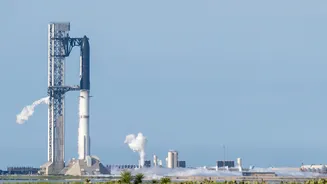
The 15th test flight of the world's most powerful rocket began with a picture-perfect liftoff from Starbase, Texas. All 33 Raptor engines on the Super Heavy booster roared to life, propelling the Starship upper stage towards orbit. However, the mission's
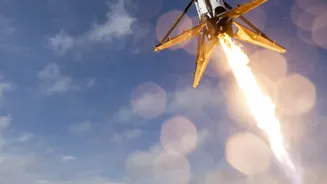
first major test—recovering the booster—ended in failure. During its return burn, an anomaly occurred, and the booster's guidance system automatically aborted the landing attempt. Instead of being caught by the launch tower's mechanical arms, it was diverted for a splashdown in the Gulf of Mexico, where it was lost. While a significant setback, it was the fate of the upper stage that would ultimately define the mission. The Starship itself successfully separated, continued into orbit, and spent the next 22 hours circling the Earth.
The Landmark Catch
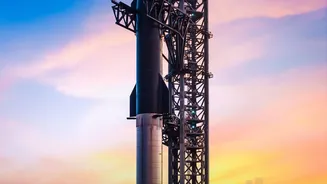
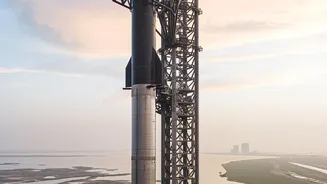
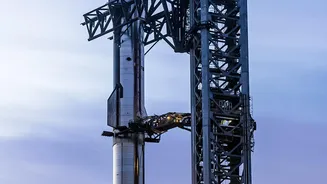
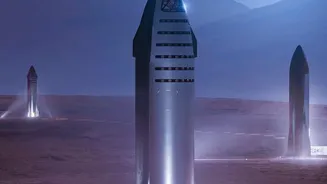
After completing 14 orbits and deploying a batch of 26 Starlink satellites, the Starship spacecraft, known as 'Ship 42', began its journey home. The world watched as it performed a series of complex atmospheric reentry maneuvers, with its heat shield glowing under the intense heat. The final moments were the most critical. The spacecraft flawlessly executed its landing flip and slowed its descent using its Raptor engines, positioning itself precisely between the giant 'chopstick' arms of the launch tower, nicknamed 'Mechazilla'. For the first time ever, the tower's arms closed in and successfully caught the orbital-class spacecraft, leaving it suspended in the air. The achievement marked a historic milestone, proving that the upper stage of an orbital rocket can be recovered directly at its launch site.
Why Full Reusability Is a Game-Changer
SpaceX's entire Starship program is built on the foundation of full and rapid reusability. Unlike its workhorse Falcon 9 rocket, where the second stage is expended, the goal for Starship is to recover and refly both the booster and the ship. Catching the vehicles with the launch tower eliminates the need for heavy landing legs, saving weight that can be used for payload instead. More importantly, it dramatically speeds up the turnaround time between launches. The vision is to treat the rocket more like a commercial airliner, capable of flying multiple times a day, not just once every few months. This high flight cadence is essential for making space travel more affordable and is the only way SpaceX believes it can achieve its long-term goals, such as deploying thousands more satellites, building a base on the Moon for NASA's Artemis program, and ultimately, establishing a city on Mars.
Two Steps Forward, One Step Back
The loss of the Super Heavy booster is a tangible financial and engineering setback, as each one carries 33 advanced Raptor engines. The failure highlights the immense challenge of recovering two massive stages in a single, coordinated mission. However, SpaceX's iterative development philosophy—test, fly, fail, and fix—has proven effective. While the booster recovery system needs more work, the successful orbital flight, satellite deployment, and historic catch of the Starship spacecraft represent a massive leap forward. This mixed result provides invaluable data that will inform the next flight. For NASA, which is relying on Starship to land astronauts on the Moon, the progress is a welcome sign that the ambitious system is maturing, even if the path forward remains challenging. The day's events prove that even a partial failure can result in a monumental success, keeping the dream of a fully reusable interplanetary transport system alive.