




What Exactly Is a Brown Dwarf?
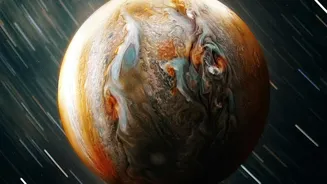
A brown dwarf is a celestial object that occupies the middle ground between the largest gas giant planets and the smallest stars. Their mass is typically between 13 and 80 times that of Jupiter. This specific mass range is what makes them so unique. They
are born from the same process as stars—the gravitational collapse of dense clouds of gas and dust. However, they never accumulate enough mass to kickstart the process that defines a true star: the sustained fusion of hydrogen into helium in their core. Despite their name, brown dwarfs are not actually brown. Depending on their temperature, they would likely appear magenta or deep red to the human eye.
The 'Failed Star' Narrative
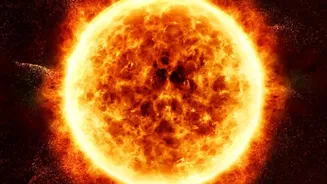
Brown dwarfs are often called 'failed stars', and for good reason. A star like our Sun shines because its immense gravity creates incredible pressure and temperature in its core, triggering nuclear fusion. To achieve this, an object needs a minimum mass of about 80 times that of Jupiter. Brown dwarfs fall short of this threshold. While they are hot and dense enough in their early life to briefly fuse deuterium, a heavier isotope of hydrogen, this process is short-lived. They lack the gravitational might to initiate the long-term hydrogen fusion that powers stars for billions of years. After this initial burst of energy, a brown dwarf spends the rest of its existence cooling and fading, like a dying ember in space.
Not Quite a Planet, Either
If they're not stars, are they just oversized planets? Not quite. The dividing line is generally drawn at a mass of about 13 times that of Jupiter. Objects below this line are considered planets, while those above are brown dwarfs, capable of that brief deuterium fusion. The other key difference lies in their formation. Brown dwarfs form directly from collapsing gas clouds, just like stars. Planets, on the other hand, typically form from the leftover disk of gas and dust that orbits a newly formed star. This fundamental difference in origin stories is why astronomers classify them separately, even though the lowest-mass brown dwarfs and the highest-mass gas giants can be similar in size.
A Spectrum of Coolness
Since brown dwarfs continuously cool as they age, their temperatures can vary dramatically, from as hot as a cool star to colder than the human body. Astronomers classify them using a spectral system based on temperature, designated by the letters L, T, and Y. L-type dwarfs are the hottest, with temperatures ranging from about 1,300 to 2,200 degrees Celsius, hot enough for mineral grains to form in their atmospheres. T-type dwarfs are cooler and are distinguished by the presence of methane in their atmospheres, much like our own solar system's gas giants. The Y-type dwarfs are the coldest and most exotic, with some having temperatures comparable to that of a hot day on Earth. The coldest known brown dwarf, WISE 0855, has a temperature below freezing.
How We Find These Elusive Objects
Because they don't shine brightly like stars, brown dwarfs are incredibly difficult to detect. They emit most of their faint energy in the infrared spectrum. This means astronomers must rely on powerful infrared telescopes to find them. The launch of instruments like the James Webb Space Telescope (JWST) has revolutionised the search. Recently, JWST has identified brown dwarfs with masses as low as just two to three times that of Jupiter, pushing the boundaries of what was thought possible and challenging star formation theories. Scientists also look for specific chemical signatures, such as the presence of lithium, which is destroyed in true stars but can survive in the less-hot interiors of brown dwarfs, helping to confirm their identity.