


More Than Just Mimicry
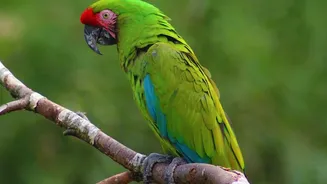
For years, we've been impressed by parrots that can say 'Hello' or squawk 'Polly wants a cracker'. We call it mimicry, but the reality is far more complex. Parrots belong to a very exclusive club of animals known as 'vocal learners'. This means they don't
just have a fixed set of innate calls; they can listen to sounds in their environment, process them, and learn to reproduce them. It's an ability humans share, along with songbirds, hummingbirds, and a few mammals like dolphins and bats. Unlike most animals, which are born with their entire vocal repertoire, parrots must learn what to say. In their natural habitats, this isn't about imitating a telephone ring, but about learning the specific language of their flock to survive and thrive.
The Science of Parrot 'Accents'
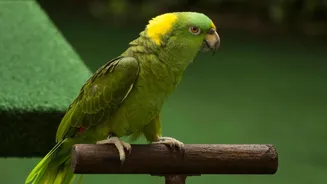
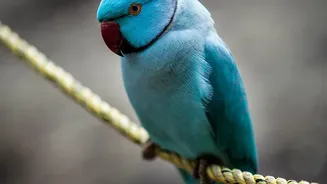
This learning ability leads to a fascinating outcome: regional dialects. Just like human languages have different accents and local slang, studies have shown that different populations of the same parrot species develop unique calls. A flock of Yellow-naped Amazon parrots in one part of Costa Rica, for instance, will have a distinct contact call—a sound used to keep in touch—that is noticeably different from another flock just a few dozen kilometres away. These are not genetic differences; they are cultural ones. A young parrot learns the specific 'accent' of the group it is raised in, ensuring it can be identified as a member of the local flock. Researchers studying monk parakeets in Europe even found that distinct dialects developed in different cities where the birds were introduced.
It's All About Fitting In
So why do they do it? The primary driver is social bonding. For a highly social creature like a parrot, being able to communicate effectively with your group is essential for everything from finding food and warning of predators to finding a mate. By adopting the local dialect, a parrot signals that it belongs. It's the avian equivalent of learning local slang to fit in with a new group of friends. Scientists have observed that when parrots move to a new flock, they will often change their calls to match their new companions. This vocal flexibility demonstrates that their learning isn't just a childhood phase; it's a lifelong skill used to navigate their complex social world. The 'words' they choose are all about maintaining relationships.
A Shared Evolutionary Path
The most profound part of this discovery is what it tells us about the evolution of complex communication. Recent research into the parrot brain has revealed some stunning parallels with our own. While birds and humans are separated by hundreds of millions of years of evolution, scientists have found that the brain structures parrots use for vocal learning are remarkably similar to the ones humans use for speech. Specifically, parrots have a unique brain structure—a 'shell' system around their vocal learning cores—that other vocal-learning birds like songbirds lack. This specialized neural hardware may be what gives them their exceptional ability to imitate and adapt sounds. This is a clear case of 'convergent evolution', where two different species independently evolve a similar solution to a similar problem—in this case, the problem of complex vocal communication.
A Window Into Our Own Speech
Studying how parrots learn, adapt, and use their 'accents' isn't just for the birds. It provides a unique, non-primate model for understanding the biological and neurological foundations of speech. Because their brains have converged on a system similar to ours for producing flexible sounds, researchers believe they could be an important model for studying human speech disorders. By understanding the 'vocal keyboard' in a budgie's brain—how specific neural patterns drive different sounds—we may gain new insights into what happens when human speech breaks down. These feathered chatterboxes are more than just clever mimics; they are a living, breathing experiment in the evolution of language, offering clues to one of the most fundamental aspects of being human.