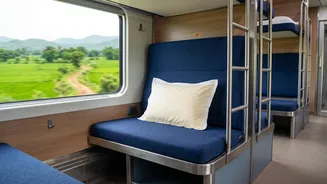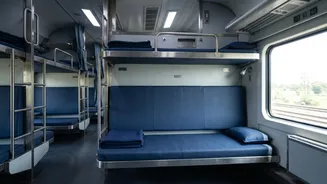







Your Preference is a Request, Not a Command
The most important thing to understand about booking a train ticket on IRCTC is that your berth preference—Lower, Middle, Upper, Side Lower, or Side Upper—is treated as a request, not a guarantee. The final allocation is handled by a complex algorithm
that juggles dozens of factors, including availability, quotas, and even the need to distribute weight evenly across the train for safety. When you select 'Lower Berth', you are telling the system your preference. If a lower berth is available within the quota you're booking under and satisfies other system rules, you have a good chance of getting it. However, if they are already taken, the system will assign you the next available berth.
The Powerful Role of Quotas
Indian Railways divides seats into more than a dozen different quotas to serve various passenger categories. The General Quota (GN) is the largest pool, open to everyone and typically accounting for 60-70% of seats. However, many other quotas have their own set of berths. The Ladies Quota (LD) reserves a small number of lower berths for women travelling alone or with a young child. The Senior Citizen quota (SS) is a key one for berth allocation. Male passengers aged 60 and above and female passengers aged 45 and above are given priority for lower berths. This happens automatically when you enter the correct date of birth during booking; the system flags the passenger as eligible. There are also quotas for Divyangjan (persons with disabilities), Defence personnel, and last-minute travellers under the Tatkal (TQ) and Premium Tatkal (PT) schemes. Each of these quotas operates with its own pool of available seats, which is why a train might show 'Not Available' in the General quota but still have seats in Tatkal.
How the Allocation Algorithm Thinks
The IRCTC booking system, officially known as the Passenger Reservation System (PRS), uses an algorithm to assign berths. This software first allocates berths to passengers who qualify for special quotas. For instance, it will prioritise assigning available lower berths to senior citizens, pregnant women, and women over 45 who have booked tickets. After processing these priority requests, the system moves on to the General quota. It tries to keep passengers on the same PNR together in the same coach or bay. It also allocates berths sequentially to ensure passenger load is distributed evenly across all coaches, which is important for the train's stability and safety. This is why you cannot pick a specific berth number from a seat map like you would for a movie or a flight. The system is designed for mass allocation and operational safety, not individual selection.
Practical Tips to Improve Your Chances
While you can't force the system, you can work with it to increase your odds of getting a desirable berth. 1. Book as Early as Possible: The advance reservation period (ARP) typically opens 120 days before the journey. Booking the moment it opens gives you the best shot, as the pool of available berths is at its largest. 2. Enter Correct Passenger Details: For senior citizens or women over 45, entering the correct age is crucial for the system to automatically grant lower berth priority. 3. Use Specific Booking Options: When booking for a group, you can use the 'Book only if all berths are allotted in the same coach' option. For lower berth seekers, there is also an option to 'Book only if at least one lower berth is allotted', which will prevent the booking from completing if no lower berth is available. 4. Consider 2AC: If your budget allows, AC 2-Tier coaches have a higher probability of landing you a lower berth. With only lower and upper berths (no middle), your chances are effectively 50/50, compared to about 33% in 3AC or Sleeper class. 5. Check After Chart Preparation: The first reservation chart is usually prepared a few hours before departure. At this point, any unused quota berths are released to the general waitlist, and cancellations can free up seats. It is worth checking your PNR status again at this time.