



From Flight Surgeon to Orbit
Anil Menon’s path to the stars is as impressive as the mission itself. A colonel in the U.S. Space Force, he is also an emergency medicine physician with extensive experience in wilderness medicine and frontline deployments. Before being selected as a NASA
astronaut in 2021, Menon was SpaceX's first-ever flight surgeon, where he helped establish the company's medical program and supported its historic first human spaceflights. This unique blend of medical expertise and aerospace experience makes him exceptionally qualified for his current role. Born to a father from Kerala and a mother from Ukraine, Menon’s journey has been a source of immense pride, particularly in India. He even spent a year in India as a Rotary Ambassadorial Scholar supporting polio vaccination efforts, forging a deep connection with the country.
An Eight-Month Marathon in Microgravity
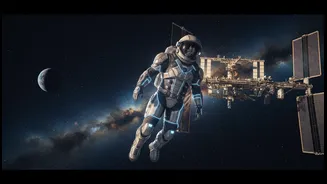
Menon launched to the International Space Station (ISS) aboard a Soyuz spacecraft from the Baikonur Cosmodrome in Kazakhstan on July 14, 2026, alongside two Roscosmos cosmonauts. Their arrival marked the beginning of an extended eight-month stay aboard the orbiting laboratory as part of Expedition 74/75. Long-duration missions like this are fundamental to understanding the profound effects of space on the human body, including muscle atrophy, bone density loss, and changes in fluid dynamics. Each day in orbit is a carefully orchestrated sequence of scientific experiments, station maintenance, and physical exercise designed to counteract the physiological toll of microgravity. The data collected from these extended missions are invaluable, serving as the foundation for planning future voyages to the Moon and Mars.
The Human Factor in Future Astronomy
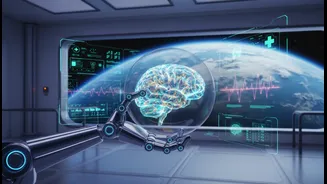
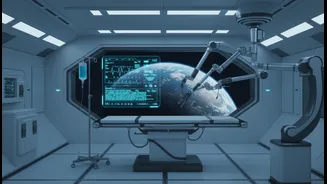
While Menon’s mission isn't focused on gazing through a telescope, his work is profoundly crucial for the future of astronomy. The next great astronomical leaps—such as building observatories on the Moon or sending geologist-astronauts to Mars—depend entirely on our ability to keep humans healthy on long journeys far from Earth. Menon’s expertise is central to this goal. He is conducting and serving as a test subject in several key medical studies. These include examining changes in blood flow, testing AI-guided ultrasound that could allow for autonomous medical care, and even bioprinting vascular tissues to better understand aging. By solving the human health puzzle, Menon is laying the groundwork that will one day allow astronomers to conduct their work in deep space.
A Laboratory Paving the Way for New Worlds
The ISS is a unique laboratory where the absence of gravity unlocks new scientific possibilities. Beyond human health, Menon's mission includes experiments with direct links to the technologies that will power future exploration and benefit life on Earth. A key area of research is the production of semiconductor crystals in microgravity. Perfecting this process in space could lead to breakthroughs in manufacturing components for high-performance computers and AI systems. While some astronomy on the ISS involves external instruments that monitor cosmic rays and black holes, the research happening inside is just as important. By refining life support, manufacturing, and medical technology, Menon and his crewmates are building the toolkit humanity will need to establish a sustained presence beyond Earth orbit.
An Inspiration for India and the World
Anil Menon’s presence on the ISS serves as a powerful symbol of inspiration, particularly for a nation with its own ambitious space program. As India prepares for its Gaganyaan human spaceflight mission, the learnings from astronauts of Indian origin on the ISS are incredibly valuable. Menon's journey from a small town in Kerala's Palakkad district to the pinnacle of space exploration showcases a world of possibilities for a new generation of scientists, engineers, and dreamers in India. His mission highlights the collaborative nature of modern space exploration, where international crews work together to achieve common goals. It reinforces the idea that space is a domain not just for a handful of nations, but for all of humanity.