

A Glimpse of Our Sun's Future
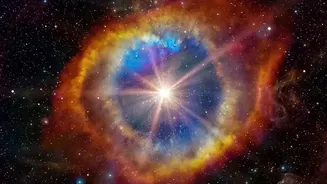
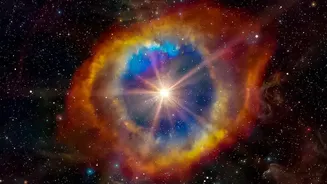
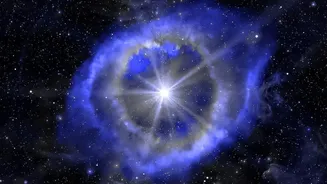
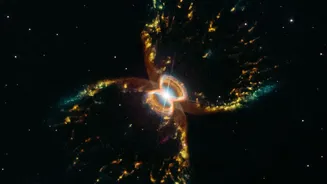
Located about 650 light-years away, the Helix Nebula is one of the closest and most striking examples of a planetary nebula. Despite the name, these objects have nothing to do with planets. Instead, they are the elaborate, expanding shells of gas and dust
ejected by a star like our own Sun at the end of its life. For centuries, astronomers have studied the Helix, sometimes called the "Eye of God," to understand this final chapter of stellar evolution. This nebula offers a preview of the process our own solar system will likely undergo in billions of years, making it a crucial natural laboratory for understanding how stars die and recycle their materials back into the cosmos.
The Mystery of the Cometary Knots
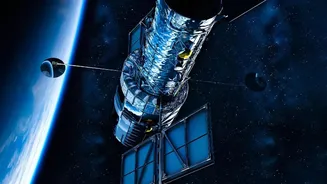
Sprinkled throughout the nebula are thousands of tiny, tadpole-shaped objects that have long puzzled scientists. Dubbed "cometary knots" because their glowing heads and long tails resemble comets, these structures are anything but small. Each knot's dense, gaseous head can be twice the size of our entire solar system, with tails stretching for a staggering 100 billion miles. While they were first observed by the Hubble Space Telescope, their true nature remained shrouded. Astronomers knew they were there, but couldn't fully explain how they formed or survived in such a chaotic environment. These knots are incredibly dense, containing about as much mass as the Earth.
Forged by Dueling Stellar Winds
The prevailing theory for how these knots are made involves a cosmic collision of winds. As the star at the nebula's center aged, it first shed its outer layers as a slow-moving cloud of cool gas and dust. Later, as the star's hot core became exposed, it unleashed a much faster, more energetic stellar wind. This high-speed wind, traveling at blistering speeds, slams into the older, clumpier material that was ejected thousands of years prior. The impact sculpts the dense, cool gas into these resilient, comet-like shapes, with the faster wind eroding them and creating their signature streaming tails. It’s a magnificent, large-scale demonstration of cosmic weather shaping a celestial landscape.
Why Webb's View Is a Game-Changer
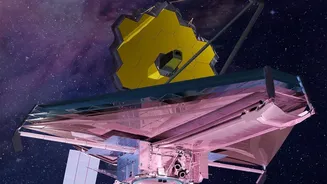
This is where the James Webb Space Telescope's power comes into play. Unlike Hubble, which primarily sees in visible and ultraviolet light, Webb is optimized for infrared light. This allows it to peer through the obscuring layers of gas and dust to see the cooler, molecular material that makes up the bulk of these knots. Webb’s new images provide an unprecedentedly clear view, bringing the knots into sharp focus and revealing intricate details within their structure. For the first time, scientists can analyze the transition from the hot, ionized gas at the head of the knots to the cooler molecular gas trailing behind in their tails, providing critical data to test and refine theories about their formation.
More Than Just a Pretty Picture
Studying these knots isn't just about solving a cosmic riddle; it's about understanding how the universe recycles itself. The material within these knots is pristine matter shed from the dying star, containing heavy elements forged inside it over billions of years. These dense, dusty globules act as protective pockets, potentially allowing more complex molecules to form within them, shielded from the harsh radiation of the central star. In essence, the death of one star is seeding the interstellar medium with the raw materials needed for the next generation of stars and, eventually, new planets. Webb's detailed portrait of the Helix Nebula is a stunning confirmation that even in its final moments, a star is a powerful architect of the future.