





Beyond the 'Just Right' Orbit
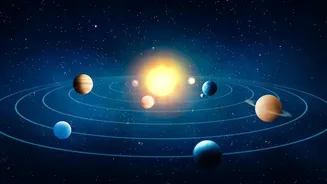
The idea of a habitable zone is a useful starting point in the search for life. It defines the orbital range around a star where a planet could theoretically maintain liquid water on its surface, a key ingredient for life as we know it. This concept,
easy to grasp and exciting, has dominated headlines for years. However, this simple rule of cosmic real estate is proving to be fundamentally incomplete. Finding a planet in this zone is merely the first step on a long checklist. A planet can be in the perfect spot and still be a barren, hostile world, as the case of Mars in our own solar system demonstrates. True habitability is a complex interplay of many different variables, and scientists are now moving beyond this single-factor approach.
The Star's Temperament Matters
A planet's host star is a critical, and often disruptive, factor. Many exoplanets are found orbiting red dwarf stars, which are smaller and cooler than our sun. Their habitable zones are much closer to the star. The problem is that these stars, especially in their youth, are notoriously volatile, prone to lashing out with powerful stellar flares and coronal mass ejections. This constant barrage of high-energy radiation can strip away a planet's atmosphere over time, leaving it exposed and lifeless. The star’s age and stability are paramount; a calm, predictable star provides a much safer environment for life to emerge and evolve over billions of years. Some research even suggests that while flares can be destructive, a certain amount of UV radiation from them might kickstart the chemical processes needed for life, adding another layer of complexity.
An Atmospheric Shield and Blanket
Simply being the right temperature for liquid water is meaningless if the planet can't hold onto an atmosphere. A planet that is too small will have insufficient gravity to prevent its atmosphere from being blown away by stellar winds. Conversely, a planet that is too large may become a gas giant with a crushing atmosphere thousands of kilometres thick. A suitable atmosphere does more than provide air to breathe; it creates the necessary surface pressure to keep water in a liquid state, shields the surface from harmful radiation, and traps heat through the greenhouse effect to regulate temperature. Without this protective blanket, a planet's surface can experience wild temperature swings, making it inhospitable.
The Unseen Planetary Defender
A planet’s magnetic field is an invisible shield that is crucial for long-term habitability. Generated by the motion of a molten core, a magnetic field deflects the charged particles of the stellar wind, protecting the atmosphere from being slowly eroded into space. Without a robust magnetic field, even a perfectly positioned, Earth-sized planet could lose its atmosphere and its water, eventually becoming a dry, irradiated desert. The presence of a magnetic field is so important that scientists are developing new methods to detect these fields around distant exoplanets, as it's considered a key indicator of a planet's potential to sustain life.
Geology, Chemistry, and Composition
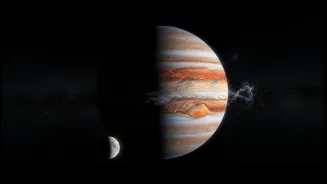
A planet is not a static ball of rock. Its internal geology and chemical makeup are vital. A geologically active world with plate tectonics, like Earth, can help regulate its climate over long timescales by cycling carbon between the atmosphere and the planet's interior. The planet's mass and core size influence its ability to generate a magnetic field and retain internal heat, which drives this geological activity. Furthermore, the building blocks for life—elements like carbon, hydrogen, nitrogen, oxygen, and phosphorus—must be available. Even the presence of other planets in the system plays a role; large gas giants in stable, distant orbits, sometimes called "Good Jupiters," can help protect inner rocky worlds from catastrophic asteroid impacts.