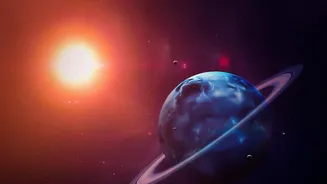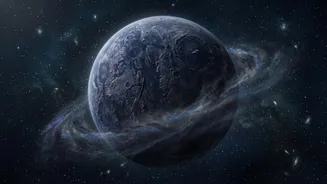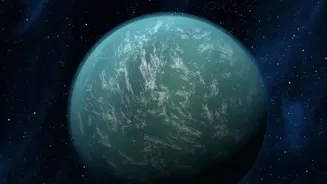

In a celestial mystery that has puzzled astronomers for over a decade, a once-celebrated exoplanet known as Fomalhaut b simply vanished. Now, new findings have cracked the case, revealing a truth far stranger than a missing world.
The Ghost Planet of Fomalhaut
First spotted in 2004
and announced with great fanfare in 2008, Fomalhaut b was a landmark discovery. Located just 25 light-years from Earth, it was one of the very first exoplanets to be directly imaged—a faint speck of light orbiting the brilliant star Fomalhaut. Astronomers celebrated the finding as a major step forward in studying worlds beyond our solar system. Initial estimates suggested it was a massive gas giant, perhaps up to three times the size of Jupiter. It was given the official name 'Dagon', and its discovery offered a rare, direct glimpse into a developing planetary system. For years, it was a poster child for exoplanet hunters, a tangible world in a distant solar system.
A Cosmic Disappearing Act
However, the more astronomers studied Fomalhaut b, the stranger it became. For a massive planet, it was unusually bright in visible light but had no detectable heat signature in the infrared, a puzzling contradiction. Planets, especially young ones, should be warm enough to glow in infrared light. Furthermore, its orbit seemed highly unusual, appearing to be on a path that would either take an extremely long time to circle its star or, more bizarrely, fling it out of the system entirely. The mystery deepened when follow-up observations by the Hubble Space Telescope in 2014 showed the unthinkable: the planet was gone. The faint dot of light had faded and dispersed, leaving astronomers to wonder whether it had ever been a planet at all.
The Dust Cloud Hypothesis
The leading theory to explain the vanishing act was that Fomalhaut b was never a solid world. Instead, scientists proposed it was a vast, expanding cloud of fine dust created by a cosmic collision. This would explain why it was bright in visible light (reflecting starlight) but cold in the infrared. Such an event would be incredibly rare to witness. The hypothesis suggested that astronomers had been lucky enough to spot the immediate aftermath of a titanic smash-up between two large, icy bodies, each estimated to be about 200 kilometres in diameter. According to this model, the resulting debris cloud was rapidly expanding and dissipating, which is why it seemed to fade and eventually disappear from view.
Fresh Clues Close the Case
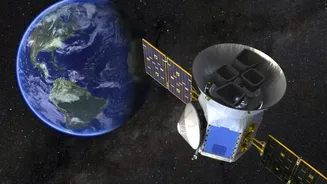
The final confirmation of this theory has arrived thanks to fresh observational findings. Armed with powerful instruments like the James Webb Space Telescope (JWST), astronomers have conducted the most detailed analysis of the Fomalhaut system to date. These new observations, which can peer into the system with unprecedented clarity in infrared light, found no trace of a massive planet where Fomalhaut b was supposed to be. The absence of a large, heat-emitting body has effectively ruled out the planet hypothesis. The JWST data confirmed that the object's characteristics were entirely consistent with a dispersing dust cloud, providing the final piece of evidence needed to close this long-standing astronomical case file.
A New Understanding of Planetary Chaos
While Fomalhaut b may not be the planet we once thought, its story is arguably more exciting. Instead of observing a stable world, astronomers realised they had front row seats to the chaotic 'demolition derby' phase of planetary system formation. Witnessing the aftermath of such a massive collision provides invaluable data on how systems like our own evolve. These events, though destructive, are a crucial part of the process that clears out debris and shapes the final architecture of a solar system. The resolution of this mystery is a perfect example of the scientific method in action : a hypothesis was proposed , challenged by new data , and ultimately replaced by a better explanation that fits all the evidence . Fomalhaut b may be a 'ghost planet', but its legacy offers a real and dramatic insight into the violent birth of worlds.