


Two Types of Day
First, let's untangle that headline. When we say a day on Mercury is 59 Earth days long, we’re talking about its 'sidereal day'—the time it takes to complete one full rotation on its axis. If you were watching from a distant star, you’d see a single point
on Mercury’s surface return to its starting position in 58.6 Earth days. However, what a creature on the surface would experience is a 'solar day'—the time from one sunrise to the next. Because Mercury is also speeding around the Sun (a year on Mercury is only 88 Earth days!), its solar day is much, much longer: a staggering 176 Earth days. This means a single Mercurian day is twice as long as its year. You could celebrate two birthdays in the time it takes for the Sun to rise again.
The 3:2 Spin-Orbit Resonance
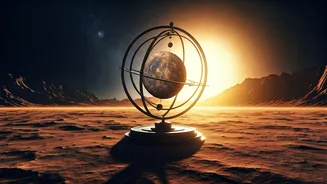
So why is Mercury’s rotation so bizarre? The answer lies in something called 'spin-orbit resonance'. For decades, scientists believed Mercury was 'tidally locked' to the Sun, meaning one side always faced it, just as the same side of our Moon always faces Earth. But in 1965, radar observations proved this wrong. Mercury is in a 3:2 resonance. This means for every two trips it makes around the Sun, it rotates on its axis exactly three times. This stable, repeating pattern is the result of the Sun’s immense gravitational pull acting on the planet’s slightly elongated shape. Think of it like a perfectly timed dance: for every two steps around the dance floor (orbits), the dancer completes exactly three spins (rotations). This unique rhythm defines everything about the planet.
A Planet of Fire and Ice
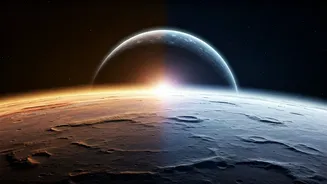
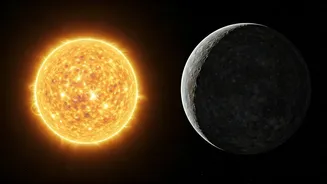
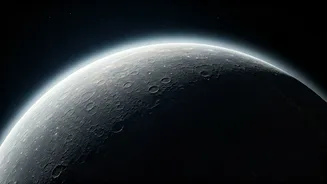
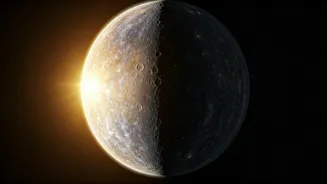
The consequences of this long solar day are extreme. The side of Mercury facing the Sun gets to bake for months on end, with surface temperatures soaring to a blistering 430° Celsius—hot enough to melt lead. Without a substantial atmosphere to trap and distribute this heat, the night side tells a different story. As it faces away from the Sun for its long night, temperatures plummet to an unimaginably cold -180° Celsius. This makes Mercury a planet of the most dramatic extremes in our solar system. While the surface is either scorching or freezing, scientists have found evidence of water ice tucked away in permanently shadowed craters near the poles, where the Sun’s rays never reach.
The Sun's Strange Journey
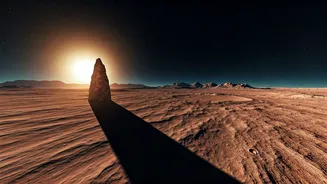
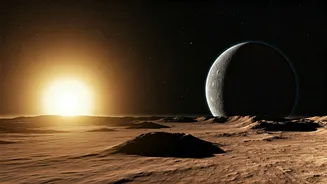
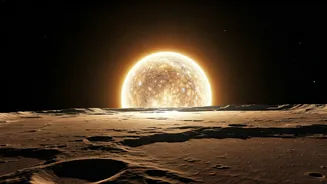
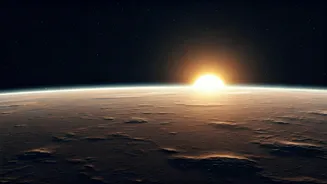
If you were to stand on Mercury and watch the sunrise, you’d witness a truly spectacular show. Because Mercury’s orbit is highly elliptical (oval-shaped), its speed varies. When it’s closest to the Sun (a point called perihelion), its orbital speed is so fast that it actually outpaces its rotational speed. For an observer on the ground, this would cause the Sun to appear to rise, stop in the sky, move backward for a short period, and then resume its slow journey toward the horizon. This retrograde motion of the Sun is a unique visual quirk caused by the interplay between the planet’s slow spin and its rapidly changing orbital velocity. It’s a celestial phenomenon unlike anything seen from Earth.