





Meet the 'Warm Neptunes'
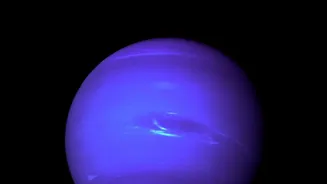
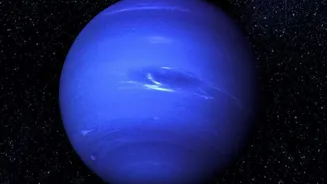
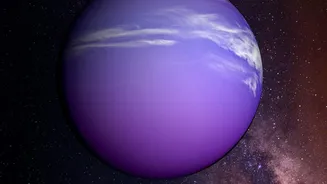
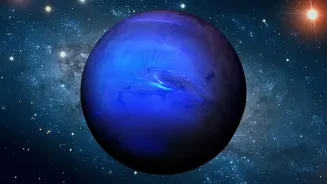
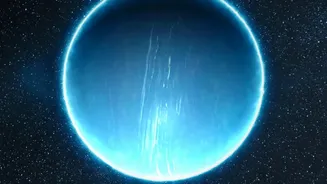
Imagine a planet larger than Earth but smaller than our own Neptune. Now, move that planet incredibly close to its star, far closer than Mercury is to our sun. This is the realm of 'warm Neptunes,' a common but mysterious class of exoplanet that has no
direct comparison in our solar system. These worlds are fascinating to astronomers because they occupy a unique middle ground. They are not small, rocky planets, nor are they colossal gas giants. Their atmospheres are expected to be thick and rich in hydrogen, but their proximity to their host star means they are blasted with intense radiation, creating conditions that are anything but stable.
The Methane Mystery
One of the key molecules scientists hunt for in these atmospheres is methane. On a planet with a hydrogen-rich atmosphere and temperatures like those on a warm Neptune, chemical models predict that methane should be abundant. It is a simple, stable molecule that should form naturally. However, observations from the James Webb Space Telescope (JWST) have presented a puzzle. On several of these planets, including the well-studied WASP-107 b, methane is found in far smaller quantities than expected—sometimes depleted by a factor of 1,000. This striking lack of methane tells scientists that something powerful is happening in the upper atmosphere, breaking the molecule apart faster than it can be replenished from below. This is where the story gets really interesting.
A Cascade of Complex Chemistry
The culprit behind the missing methane is the very star the planet orbits so closely. The intense ultraviolet radiation from the star acts like a chemical blowtorch, blasting apart the methane (CH4) in a process called photochemistry. This isn't a simple one-way street. When methane is destroyed, its constituent carbon and hydrogen atoms don't just disappear; they enter a chaotic chemical cascade. These reactive fragments combine with other elements in the atmosphere, such as sulfur, to form a whole host of new, more complex molecules. Recent JWST observations have revealed the presence of molecules like sulfur dioxide (SO2) and carbon dioxide, which shouldn't be there in such quantities under normal equilibrium conditions. Their presence is a direct fingerprint of this vigorous, radiation-driven chemistry at work. It suggests an atmosphere that is constantly being churned and changed by its star's energy.
From Detection to Understanding
These findings mark a major step forward in our study of distant worlds. For years, astronomers were focused on simply detecting exoplanets. Now, with instruments like JWST, we are moving into the era of characterization. Instead of just knowing a planet is there, we can probe its atmosphere and understand the physical and chemical processes that shape it. Studying this complex gas chemistry does more than just solve the methane puzzle. It provides crucial clues about the planet's history. For instance, the specific mix of chemicals can help scientists infer details about the planet's core, how much mixing there is between the hot interior and the upper atmosphere, and even how the planet might have formed and migrated to its current orbit.