





The Final, Critical Step
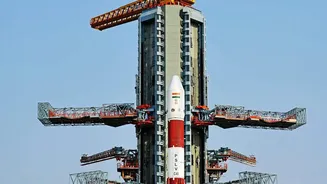
For any human spaceflight mission, the final moments are among the most perilous and important. After enduring the violent forces of launch and the harsh environment of space, astronauts must return safely to Earth. The Gaganyaan programme envisages launching
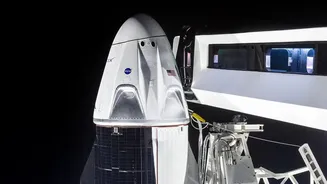
a crew of three into a 400 km orbit and, after a three-day mission, bringing them back for a splashdown in Indian territorial waters. This makes the recovery of the crew module from the ocean a paramount objective. Any number of issues, from launch pad emergencies to in-flight aborts during ascent, necessitate a flawless, rapid recovery plan to ensure the crew's survival. Success isn't measured when the rocket lifts off, but only when the crew is safely back on solid ground.
A Partnership of Space and Sea
Executing this complex task requires a specialised partnership. The Indian Space Research Organisation (ISRO) brings its deep knowledge of the Crew Module's engineering, systems, and post-splashdown behaviour. They design the hardware, from the parachutes that slow its descent to the flotation systems that keep it upright in the water. The Indian Navy, as the lead agency for recovery operations, provides the maritime muscle and expertise. This includes dedicated ships, elite teams of divers, and decades of experience in search-and-rescue missions on the high seas. Together, they form a blended team capable of locating, securing, and retrieving a small capsule from the vastness of the ocean, often under challenging conditions. The collaboration is essential for developing and refining the Standard Operating Procedures (SOPs) that will govern every step of the real mission.
Rehearsing for Reality: Inside the Drills
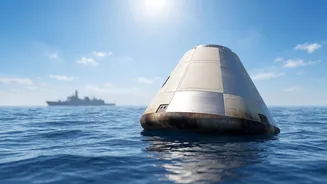
These recovery operations are not left to chance; they are practiced with painstaking detail. The joint teams use a Crew Module Recovery Model (CMRM), a mock-up that perfectly simulates the mass, size, and center of gravity of the actual capsule. The trials have been conducted in multiple phases. Initial tests took place in the controlled environment of the Navy’s Water Survival Test Facility (WSTF) in Kochi, a state-of-the-art pool that can simulate different sea states and weather conditions. This was followed by harbour trials in Visakhapatnam, where teams practiced towing the module and lifting it onto a ship's deck. More advanced trials have taken place in the open sea of the Bay of Bengal, using the actual ships designated for the mission. Divers practice attaching buoys and towing lines, while ship crews rehearse the delicate process of hoisting the module aboard using specialised cranes and fixtures.
The Technology of a Safe Return
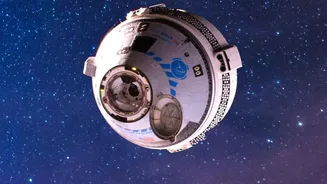
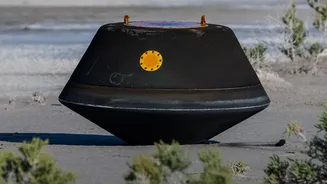
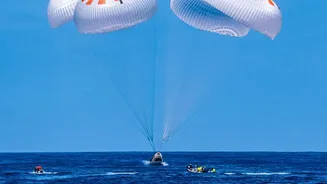
A suite of technologies is employed to make the recovery possible. After its fiery re-entry, the crew module deploys a series of parachutes to slow its descent for a soft landing in the water. Once it splashes down, flotation systems inflate to ensure it remains stable and upright. To help recovery teams find it, the module is equipped with GPS transmitters and emergency beacons. It also releases a fluorescent sea marker dye to create a large, visible patch in the water for aerial spotting. The recovery ships, like those with a 'well deck' that can be flooded to allow the module to be gently towed inside, represent another key piece of hardware. Every piece of equipment is tested and every procedure validated during these drills to minimize the time it takes to recover the crew.
From Drills to Launch Day
The successful Test Vehicle Abort Mission (TV-D1) in late 2023 was a major validation of this process, where a real crew module was separated from its rocket mid-flight and successfully recovered by the Navy after splashing down. These ongoing trials are more than just practice; they are about building institutional memory and perfecting a complex ballet of coordination between two of India's premier organizations. Every simulated recovery, from the calm waters of a training pool to the unpredictable swells of the open ocean, builds confidence and fine-tunes the procedures that will be used during both nominal and off-nominal mission scenarios. This ensures that when Indian astronauts look out their window after splashing down, the reassuring sight of an Indian Navy vessel will be closing in swiftly to bring them home.