


Neptune’s Ghostly Rings
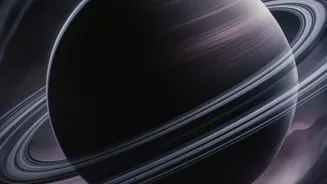
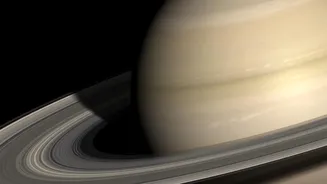
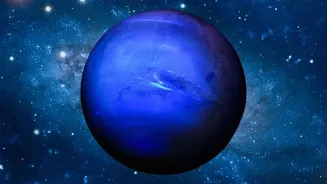
First confirmed by the Voyager 2 spacecraft in 1989, Neptune's rings are a faint, dark, and dusty collection of five main structures named after astronomers instrumental in the planet's discovery: Galle, Le Verrier, Lassell, Arago, and Adams. Unlike Saturn’s
bright rings of water ice, Neptune’s are composed of dark, dusty material, likely organic compounds that have been darkened by radiation over millennia. This dark composition makes them incredibly difficult to see from Earth. But their most peculiar feature isn’t their darkness; it’s that one of them is clumpy. While most rings are a continuous, even sheet of material, Neptune's outermost ring, Adams, looks more like a string of pearls.
The Mystery of the Ring Arcs
The Adams ring contains five distinct, brighter, and denser sections known as ring arcs. These have been named Fraternité, Égalité 1 and 2, Liberté, and Courage. From a physics perspective, these shouldn't exist. The laws of motion predict that particles in a ring, through constant collisions and interactions, should spread out evenly over a very short time. Any clump of material should quickly disperse to create a uniform ring. The fact that Neptune’s arcs are stable, having changed only slightly since they were first detected, presented a major puzzle for astronomers. Something must be holding these dust particles together, preventing them from spreading out across the entire orbit.
A Shepherd Moon's Gravitational Dance
The solution to the mystery lies with a tiny moon named Galatea. Galatea orbits Neptune just inside the Adams ring, acting as a 'shepherd moon'. Its gravitational influence is the key to confining the arcs. The mechanism at play is a phenomenon known as orbital resonance. This occurs when two orbiting bodies exert a regular, periodic gravitational influence on each other. In this case, Galatea and the particles in the Adams ring are in a specific 42:43 resonance. This means that for every 43 times a particle in the ring orbits Neptune, the moon Galatea orbits exactly 42 times. This precise timing creates a repeating gravitational nudge on the ring particles.
Creating Stable 'Pockets' in Space
This regular gravitational tugging from Galatea doesn't just pull the particles; it creates a series of stable zones along the ring's orbit. These zones, known as corotation inclination resonances, act like gravitational 'corrals'. Imagine a series of waves moving through the ring; the particles can become trapped in the crests of these gravitational waves, where they are stable. There are 43 of these stable locations around the ring's circumference. While dust can exist in any of them, it appears that for reasons still being studied, it has collected primarily in the five most prominent arc locations. This gravitational shepherding by Galatea prevents the particles from smearing out, forcing them to remain clustered within these specific, confined arcs.
A Young and Dynamic System
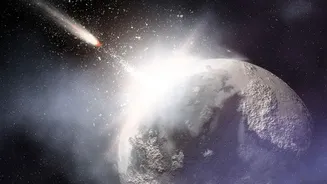
The dust that makes up these arcs is thought to originate from micrometeoroid impacts on Neptune's small inner moons. These collisions kick up debris that is then captured into orbit, forming the rings. This suggests the rings are relatively young compared to the solar system and are constantly being replenished. Observations have shown that the arcs are not perfectly static; they do show changes in brightness and position over time, indicating a dynamic and evolving system. The arc named Liberté, for instance, has been observed to be fading and could disappear within a century, while others show movement. This delicate and shifting balance makes Neptune's rings a unique natural laboratory for understanding how planetary systems form and evolve.