



A Major Leap in Complexity
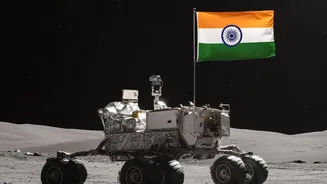
Chandrayaan-4 is not just an incremental update; it represents a monumental leap in technological capability for India's space program. While Chandrayaan-3 was a one-way trip to the lunar surface, its successor is a round-trip ticket. The mission's primary
objective is to land on the Moon, collect samples of lunar soil (regolith) and potentially sub-surface ice, and then launch from the Moon to bring those samples safely back to Earth. If successful, India will join an exclusive club of nations — the United States, Russia, and China — that have accomplished this feat. The mission is a crucial stepping stone for India’s long-term goals, which include sending an astronaut to the Moon by 2040.
Why Bring Moon Dust Home?
Studying lunar samples on Earth offers scientific possibilities that remote instruments on a lander or rover simply cannot match. Laboratories on Earth are equipped with massive, highly sensitive equipment like electron microscopes and mass spectrometers that are too large or delicate to send into space. These tools can unlock secrets about the Moon's origin, its geological history, and the evolution of our solar system. Furthermore, samples brought back decades ago by the Apollo missions are still yielding new discoveries with modern technology. Chandrayaan-4 aims to collect its samples from the geologically rich south polar region, an area largely unexplored by previous sample-return missions. This region is believed to contain water ice in permanently shadowed craters, a resource that could be vital for future lunar bases, providing drinking water, breathable oxygen, and even rocket fuel.
The Five-Part Mission Plan
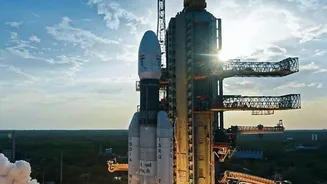
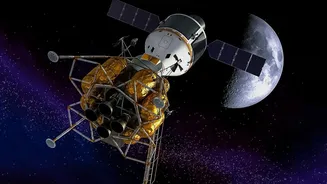
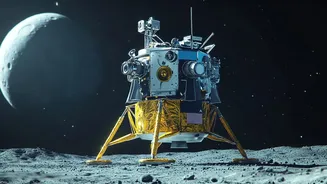
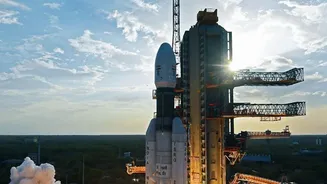
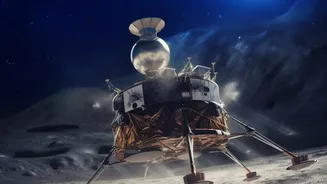
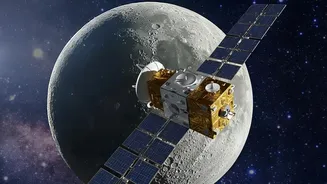
The sheer complexity of Chandrayaan-4 requires an intricate, five-module spacecraft. Because the total mass is too heavy for a single launch, ISRO will use two of its powerful LVM3 rockets. The five modules are: the Propulsion Module to travel towards the Moon, the Descender Module for the soft landing, the Ascender Module to lift off from the lunar surface with the samples, the Transfer Module to rendezvous in lunar orbit, and a Re-entry Module to protect the samples during their fiery return through Earth's atmosphere. This mission plan involves several firsts for ISRO, including launching from the surface of another celestial body and performing automated docking manoeuvres in both Earth and lunar orbit.
A Robotic Ballet in Space
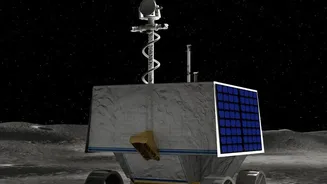
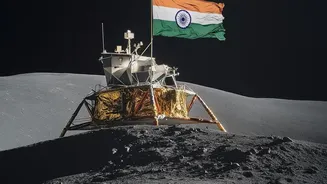
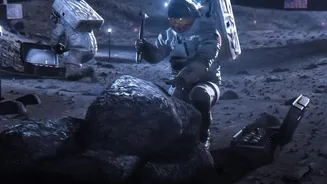
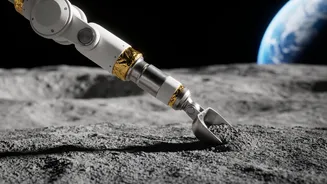
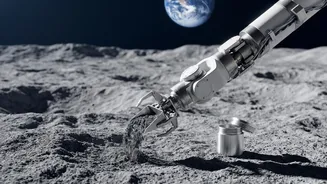
The mission will unfold like a carefully choreographed dance. First, the two launches will place the different modules into Earth's orbit, where they will dock to form a single integrated spacecraft before heading to the Moon. Once in lunar orbit, the lander and ascender will separate and descend to the surface. A robotic arm will then scoop up about 3 kilograms of soil, while a drill will collect subsurface samples, which will be sealed in containers on the Ascender Module. The Ascender will then launch from the Moon, using the lander as a launchpad, and dock with the Transfer and Re-entry modules waiting in orbit. The precious cargo is transferred, and the Re-entry module begins its journey home, designed to splash down on Earth with its priceless lunar material intact.
Timeline and Paving the Way
ISRO has been methodically developing the critical technologies needed for this mission. A key hurdle, robotic docking in space, was successfully demonstrated with the Space Docking Experiment (SPADEX) in 2025, which saw two satellites dock autonomously in Earth orbit. This successful test significantly reduces the risk for Chandrayaan-4. The Union Cabinet officially approved the mission in September 2024 with a significant budget allocation. While initial timelines pointed to 2027, ISRO Chairman S. Somanath and other official sources have indicated that a 2028 launch is more likely for this highly complex undertaking. Every step is a deliberate move towards establishing India as a major power in space exploration, capable of not just visiting other worlds, but bringing parts of them home.