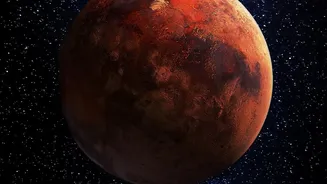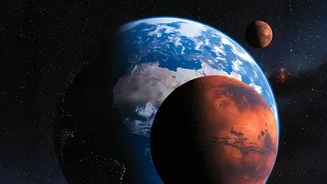






Everyone in India understands the rhythm of the seasons. But our neighbouring planet, Mars, also has them—and they are far more extreme. So what makes a Martian winter different from an earthly one? It starts with a surprising similarity.
The Tilt Is The Thing
First, let's
clear up a common misconception: seasons are not caused by how close a planet is to the Sun. They happen because a planet’s axis is tilted. On Earth, our axis is tilted by about 23.5 degrees. As we orbit the Sun, this tilt means different parts of the planet get more direct sunlight at different times of the year. When the Northern Hemisphere is tilted toward the Sun, it's summer here. When it's tilted away, it's winter. The same principle applies to Mars, which, by a cosmic coincidence, has a very similar tilt of about 25 degrees. This is the fundamental reason the Red Planet experiences four distinct seasons, just like we do.
A Year of Two Earths
The first major difference is the length of the seasons. A year on any planet is the time it takes to complete one orbit around the Sun. Earth takes about 365 days. Mars, being farther away, has a much longer journey, taking 687 Earth days to complete its orbit. As a result, every Martian season lasts roughly twice as long as its counterpart on Earth. A summer on Mars isn't a quick three-month affair; it's a long, drawn-out season that can last for nearly six Earth months.
An Egg-Shaped Orbit Changes Everything
Here's where things get really strange. Earth's orbit is nearly a perfect circle, so our distance from the Sun doesn't change much throughout the year. Mars, however, has a more eccentric, or oval-shaped, orbit. This means its distance from the Sun varies significantly. Because of this, the planet's speed changes, moving fastest when it's closest to the Sun and slowest when it's farthest away. This has a dramatic impact on the seasons. Unlike on Earth where seasons are roughly equal in length, Martian seasons vary wildly. Northern spring is the longest season at 194 Martian days (or 'sols'), while northern autumn is the shortest at just 142 sols.
A Tale of Two Hemispheres
The eccentric orbit also creates a huge difference between the northern and southern seasons on Mars. The southern hemisphere is tilted toward the Sun when Mars is at its closest point in its orbit. This makes southern summers intensely hot but also very short, because the planet is moving at its fastest. Conversely, southern winters are brutally long and cold because they occur when Mars is farthest from the Sun and moving at its slowest. This extreme seasonal imbalance is unique to Mars and is a direct result of its axial tilt and wonky orbit working together.
The Planet of Global Dust Storms
The intense heat during the southern summer does more than just warm the ground; it can trigger massive, planet-engulfing dust storms. The temperature difference between the hot southern hemisphere and the cooler north creates powerful winds that whip the fine, red Martian dust into the thin atmosphere. These aren't just local storms; they can grow to cover the entire planet for weeks or even months, blocking sunlight and causing temperatures to drop. This seasonal dust cycle is another feature that makes Mars's climate far more volatile than Earth's. The planet’s thin atmosphere also means it can't hold onto heat, leading to extreme temperature swings from day to night.