

Peering Back to the Beginning
Imagine the universe just after the Big Bang: a vast, dark, and foggy place filled mostly with hydrogen gas. For hundreds of millions of years, there were no stars to light up the cosmos. This period is aptly called the Cosmic Dark Ages. The moment the very
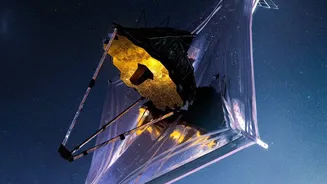
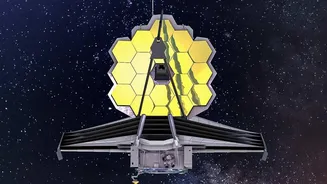
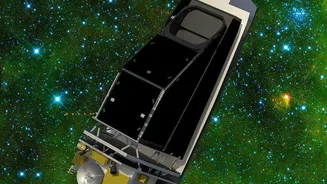
first stars ignited, bathing the universe in light for the first time, is known as the 'Cosmic Dawn'. Observing this critical era has been a primary goal of astronomy for decades. The problem is simple: these first-generation galaxies are incredibly far away, meaning their light is astronomically faint by the time it reaches us. To see them, we need a telescope of unprecedented power and sensitivity, designed specifically for the task.
The Infrared Advantage
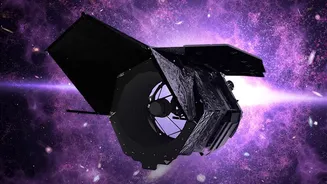
The key to Webb’s time-traveling ability lies in its specialization in infrared light. As the universe expands, the light traveling through it gets stretched into longer wavelengths, a phenomenon called 'redshift'. Light that was emitted as visible or even ultraviolet light from the first stars has been stretched so much over 13 billion years that it arrives at Earth as infrared light, which is invisible to the human eye. The Hubble Space Telescope primarily sees visible light, but Webb is engineered to capture this ancient, redshifted infrared radiation. Furthermore, early star formation happens inside thick, dusty clouds that are opaque to visible light. Infrared light, with its longer wavelength, can penetrate this cosmic dust, allowing Webb to see the stellar nurseries hidden within.
The Power of the Deep Field
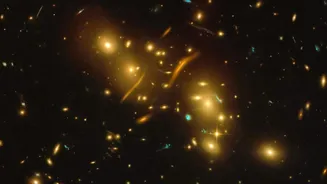
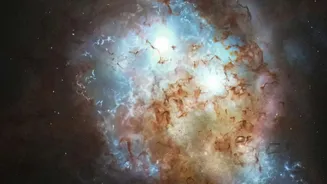
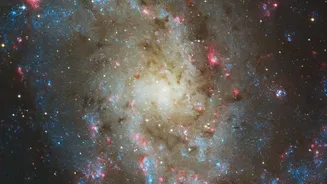
Webb doesn't just glance at the sky; it stares. The technique of 'deep field scanning' involves pointing the telescope at a seemingly empty patch of sky for an extended period—sometimes for days on end. By collecting photons over many hours, it can reveal objects billions of times fainter than what our eyes can see. Projects like the JWST Advanced Deep Extragalactic Survey (JADES) have dedicated significant telescope time to this effort. In one such deep field, astronomers found more than 45,000 galaxies. These long exposures capture the faint, stretched-out light from the most distant galaxies, effectively creating a core sample of the universe’s history in a single image. The sheer number of early galaxies discovered by JADES has already far exceeded predictions, revealing a universe that was surprisingly busy just a few hundred million years after the Big Bang.
From Faint Light to Rich Data
Capturing the light is only the first step. To map star formation, scientists use instruments like Webb’s Near-Infrared Spectrograph (NIRSpec). Spectroscopy works by breaking the light from a single galaxy into its constituent colors, like a prism creating a rainbow. This spectrum contains a wealth of information. Specific chemical elements, like hydrogen and helium, absorb and emit light at unique wavelengths, leaving barcode-like signatures in the spectrum. By analyzing how much these signatures are shifted toward the red end, astronomers can precisely calculate the galaxy’s distance and, therefore, its age. These spectra also reveal the chemical composition of early galaxies, showing what elements were available for creating the first generations of stars.
Rewriting the First Chapter
The data streaming back from Webb is already transforming our understanding of the early universe. Scientists have found hundreds of galaxies that existed when the cosmos was less than 600 million years old. Surprisingly, many of these infant galaxies show signs of intense, recent star formation and are more structured than previously thought possible for such an early epoch. It appears star formation in the early universe may have occurred in rapid, intense bursts rather than at a steady pace. These discoveries challenge existing models, suggesting that the processes that build galaxies and ignite stars got started earlier and progressed faster than we ever imagined, setting the stage for the grand cosmic structures we see today.