





A Telescope of Two Continents
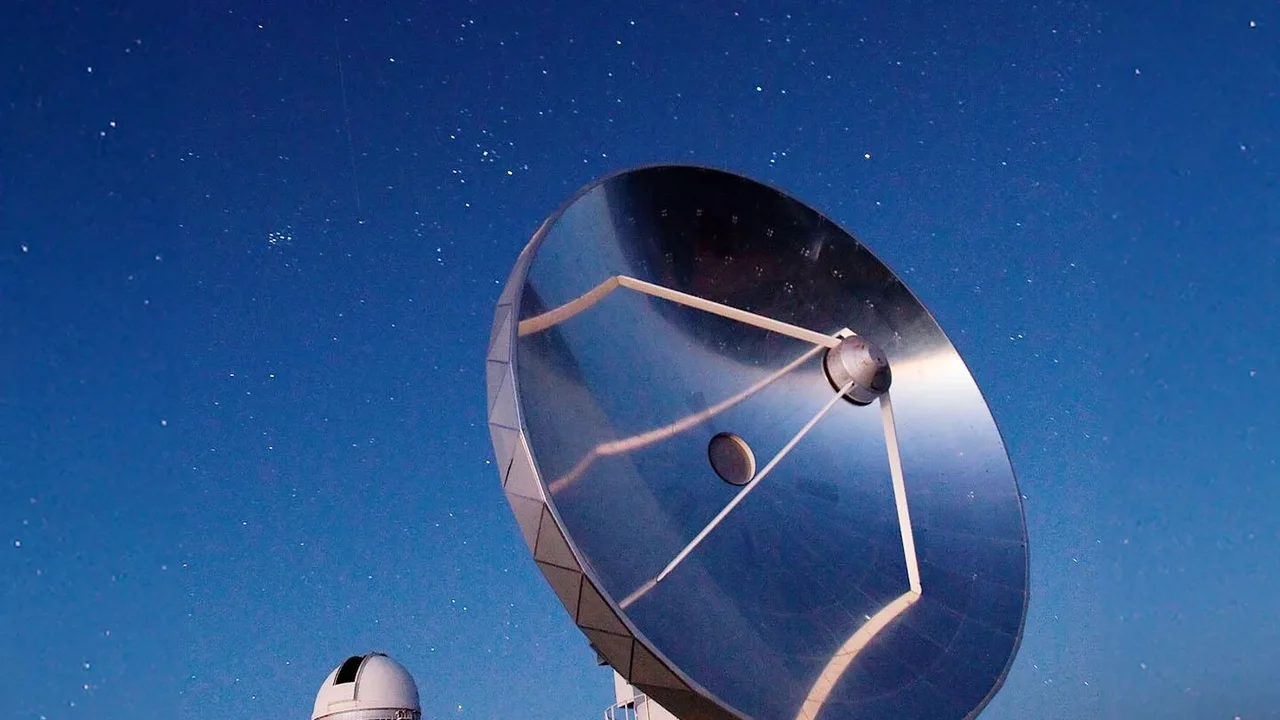
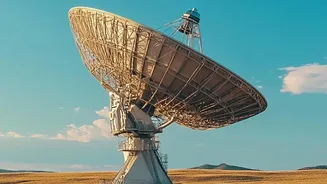
The Square Kilometre Array isn't a single telescope but a vast collection of antennas spread across two continents. It consists of two main arrays: SKA-Low in Australia, with over 130,000 Christmas tree-like antennas, and SKA-Mid in South Africa, which
will comprise nearly 200 large dish antennas. This global collaboration, with its headquarters in the UK, aims to build the world's largest and most sensitive radio telescope. Its goal is to answer fundamental questions about the universe, from how the first stars formed to testing Einstein's theories of gravity. The construction, which began in 2022, is a monumental undertaking involving scientists and engineers from over a dozen countries, including a significant contribution from India.
The Power of Many
The secret to the SKA's power lies in a technique called interferometry. Instead of building one impossibly large dish, the SKA links thousands of smaller antennas together. Signals from each antenna are collected and combined using powerful supercomputers. This allows the entire array to act as a single, virtual telescope with a collecting area equivalent to a dish one square kilometre in size. The greater the distance between the antennas, the sharper the images the telescope can produce. This principle, known as Very Long Baseline Interferometry, is what gives the SKA its extraordinary ability to see fine details in distant celestial objects. It's the combination of massive collecting area for sensitivity and long distances for resolution that makes the SKA so revolutionary.
Listening for the Cosmic Dawn
The signals the SKA is looking for are incredibly faint. Radio waves from the early universe have travelled for billions of years, stretching and weakening as the cosmos expanded. To detect these whispers from the past, the telescope's receivers must be extraordinarily sensitive and, crucially, very quiet themselves. Any heat in the electronic equipment creates its own radio 'noise', which can easily drown out a faint cosmic signal. To combat this, the receivers on the SKA-Mid dishes are cryogenically cooled to just a few degrees above absolute zero, dramatically reducing their own electronic interference. This allows the telescope to listen for specific frequencies, like the 21-cm wavelength emitted by neutral hydrogen gas, which was abundant in the early universe before the first stars lit up. Observing this signal will allow astronomers to map the universe during a mysterious period called the Epoch of Reionization, when the first stars and galaxies were born.
India’s Crucial Role in the Cosmic Quest
India, through the National Centre for Radio Astrophysics (NCRA) and a consortium of over 20 institutions, has been a pivotal partner in the SKA project since its early days. Indian engineers and scientists led the international team that designed the Telescope Manager, the complex 'brain and nervous system' that will control the entire observatory. This system is responsible for issuing commands, monitoring performance, and ensuring all the antennas work together seamlessly. Building on this success, India is now leading the development of the expanded Observatory Monitor and Control system for the construction phase. Additionally, India is making major contributions to the digital signal processing hardware for the SKA-Low telescope and the vast software needed to process the petabytes of data the SKA will generate daily.
A Deluge of Data
The sheer volume of information collected by the SKA's antennas presents one of its biggest challenges. The raw data flow will be greater than today's global internet traffic. Processing this data requires immense computing power. On-site facilities will perform initial correlations, combining the signals from the antennas in real-time. This data is then sent to dedicated supercomputers that will rank among the world's fastest, where it is calibrated and turned into usable data products for astronomers. India is also preparing to host an SKA Regional Centre, which will store a significant portion of this data and make it accessible to the nation's scientific community, leveraging the expertise developed with facilities like the Giant Metrewave Radio Telescope (GMRT) near Pune, a key SKA pathfinder.