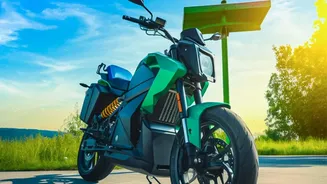






The Burning Problem in E-Bike Batteries
Lithium-ion batteries, the power source for most e-bikes, are remarkably efficient but have a dangerous flaw. If they overheat, get damaged, or are overcharged, they can enter a state called 'thermal runaway'. This is an uncontrollable chain reaction
where the internal temperature skyrockets, leading to fires and even explosions that are notoriously difficult to extinguish. In a country like India, where high ambient temperatures are common, the risk is magnified. This safety concern has been a significant hurdle for wider EV adoption and has led to stricter safety standards, but the core vulnerability of the battery chemistry remains a challenge.
A Solution from an Unlikely Source
The breakthrough comes from materials that India has in abundance: agricultural leftovers. Researchers have discovered that byproducts like rice husks, shells, and stalks can be converted into advanced carbon materials with unique properties. Rice husks, for instance, are rich in components like silica, lignin, and cellulose. For decades, this waste was either burned for low-grade energy or simply discarded. Now, scientists have developed processes to transform these natural structures into components for the next generation of batteries.
How Farm Waste Creates a Safer Battery
The science is both elegant and effective. The process involves treating the agricultural waste to isolate and refine its core components. In some research, the silica from rice husks is converted into a porous silicon structure ideal for use in battery anodes (the negative terminal). In other approaches, the tough, fibrous organic compounds like lignin and cellulose are turned into a form of 'hard carbon'. These materials can be used to create superior anodes or, crucially, act as separators within the battery. A separator is a membrane that sits between the positive and negative electrodes, preventing them from touching and causing a short circuit. The materials derived from agricultural waste are proving to be exceptionally stable at high temperatures, acting like a fire-proof barrier that can stop thermal runaway before it starts.
More Than Just Safety: The Bigger Picture
The benefits extend far beyond preventing fires. Using agricultural waste makes battery production significantly more sustainable. It reduces reliance on mined graphite, a key component often associated with a heavy carbon footprint and complex global supply chains. Furthermore, it creates a high-value product from what was previously considered low-value waste, offering a potential new revenue stream for India's vast agricultural sector. This aligns perfectly with circular economy principles, turning a local resource into a critical component for a modern industry. The resulting batteries are not only safer but could also be cheaper to produce, a key factor in making e-bikes more accessible to the masses.
From the Lab to the Road Ahead
While this technology is incredibly promising, it is still in the advanced stages of research and development. Scaling up production from the laboratory to an industrial level is the next major hurdle. It requires perfecting the conversion process to ensure consistency and cost-effectiveness for mass manufacturing. Companies specializing in battery safety materials are already working on solutions that incorporate advanced fibres and coatings to prevent thermal propagation. The innovation driven by agricultural waste represents a parallel path that could lead to even more inherently stable and eco-friendly designs. The journey from a rice husk to a battery powering an e-bike on a city street involves further engineering and investment, but the foundation has been laid for a significant leap forward.