


Your Window into the Past
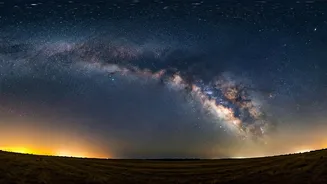
The universe is so vast that even light, the fastest thing we know, takes time to travel. When you gaze at a star, the light hitting your eye may have begun its journey when your grandparents were born, or even when the pyramids were being built. This
principle turns our telescopes into veritable time machines. The farther away an object is, the further back in time we see it. A star that is 100 light-years away appears to us as it was 100 years ago. This simple fact of physics allows us to be cosmic archaeologists, witnessing events that unfolded long before we were here to see them.
What Are 'Star Rays'?
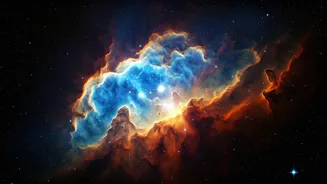
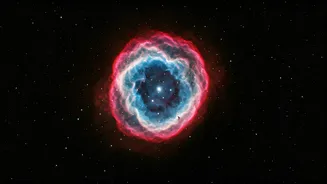
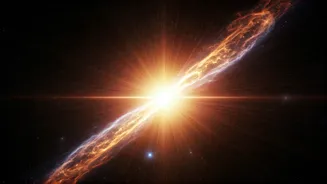
The captivating term “star rays” often refers to the spectacular, glowing clouds of gas and dust known as supernova remnants. When a massive star reaches the end of its life, it doesn't just fade away; it explodes in a cataclysmic event called a supernova. This explosion is one of the most powerful events in the universe, briefly outshining an entire galaxy. What’s left behind is an expanding shell of superheated material, energized by the shockwave and the compact stellar corpse—a neutron star or black hole—at its center. These remnants, which we see as intricate, colourful nebulae, are the visible ghosts of long-dead stars, continuing to evolve and expand through space centuries after the initial blast.
A Postcard from the Year 1054
The most famous example of this living history is the Crab Nebula. Located about 6,500 light-years away in the constellation Taurus, this stunning object is the direct result of a supernova that was seen from Earth in the year 1054. Astronomers in China and the Arab world recorded the appearance of a 'guest star' so bright it was visible during the daytime for 23 days. Today, we don't see that bright star. Instead, through a telescope, we see the aftermath: a tangled, filamentary cloud of gas stretching across 11 light-years, still expanding outward at a speed of 1,500 kilometres per second. The light we see from it tonight left the nebula 6,500 years ago, but the structure we are observing is the direct result of an explosion that lit up our planet's skies nearly a millennium ago.
How We Study These Cosmic Ghosts
While a decent amateur telescope can reveal the faint smudge of the Crab Nebula, our most powerful observatories like the Hubble Space Telescope and the James Webb Space Telescope are what bring these remnants to life. They can see in different wavelengths of light, from infrared to X-ray, which reveals different parts of the story. Infrared light can pierce through dust to show newborn stars, while X-rays can pinpoint the high-energy pulsar—a rapidly spinning neutron star—at the nebula’s heart. By studying the composition, temperature, and expansion of the gas, scientists can piece together the details of the star’s life and violent death, performing a kind of cosmic forensics on a crime scene that is thousands of years old.
A Sky Full of History
The Crab Nebula is not alone. The sky is dotted with these historical markers. The Veil Nebula, for instance, is the remnant of a star that exploded between 10,000 and 20,000 years ago. It’s so large that it spans an area of the sky six times wider than the full moon. Another, Kepler's Supernova, was observed in 1604 by the famous astronomer Johannes Kepler himself. Each one is a snapshot of a different moment in our galaxy’s history, a beautiful and violent event frozen in time by the vast distances of space. They are not just pretty pictures; they are the factories that create and distribute heavy elements like oxygen, iron, and gold across the galaxy—the very elements that make planets and life possible.