



An Ocean World in Disguise
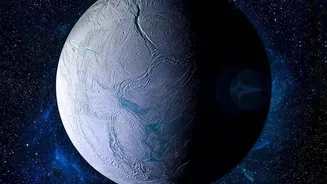
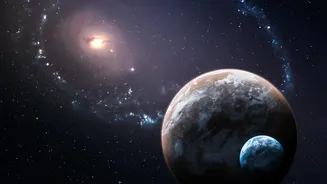
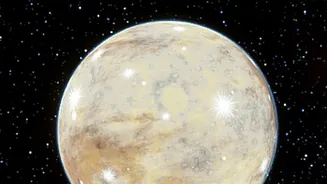
From a distance, Europa appears as a smooth, bright white orb, scarred by reddish-brown cracks. But scientists believe that beneath this frozen crust, which may be several kilometres thick, lies a vast, global ocean of salty liquid water. Evidence gathered
by previous missions like Galileo suggests this hidden ocean could contain more than twice the amount of water found in all of Earth's oceans combined. The key to this watery world is a phenomenon called tidal flexing. As Europa orbits the gas giant Jupiter, its immense gravity constantly tugs and squeezes the moon, generating enough internal heat to keep the ocean from freezing solid. This process could also create hydrothermal vents on the seafloor, similar to those on Earth that teem with life, providing a potential source of chemical energy. These three ingredients—water, chemistry, and energy—make Europa one of the most compelling places to search for life beyond Earth.
A Long and Winding Road
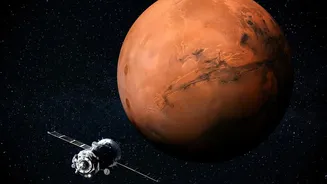
Getting to Europa is a monumental feat of celestial navigation. The Europa Clipper spacecraft, the largest NASA has ever built for an interplanetary mission, launched from Earth in October 2024. As of August 2026, it is hurtling through space on a complex trajectory. To build up enough speed for its long journey, the probe performed a gravity-assist flyby of Mars in early 2025 and is now on a path that will bring it back for one final speed boost from Earth’s gravity in December 2026. This five-and-a-half-year journey will culminate in its arrival at the Jupiter system in April 2030. Instead of orbiting Europa directly and getting fried by Jupiter’s intense radiation belts, Clipper will enter a long, looping orbit around Jupiter itself, allowing it to perform dozens of high-speed, low-altitude flybys of the icy moon over several years.
Seeing Through the Ice
So how does a spacecraft look for an ocean it cannot directly see? Europa Clipper is equipped with a sophisticated suite of nine scientific instruments designed to probe the moon from its surface to its core. To peer beneath the ice, the Radar for Europa Assessment and Sounding: Ocean to Near-surface (REASON) instrument will act like a powerful radar gun, sending radio waves through the crust to measure its thickness and search for pockets of water or even the ocean itself. At the same time, a sensitive magnetometer will measure the magnetic field around Europa. Since salty water is electrically conductive, the moon’s ocean should create a distinct induced magnetic field as it moves through Jupiter’s massive magnetic field. By studying these magnetic signatures, scientists can confirm the ocean's existence and even estimate its depth and salinity without ever touching the water.
Sniffing for Clues in Space
While some instruments look deep inside, others will focus on what might be escaping from the ocean. Scientists have seen tantalising hints of water vapour plumes erupting from Europa's surface. If Clipper can fly through one of these geysers, two key instruments will be ready to 'taste' its contents. The SUrface Dust Analyzer (SUDA) and a mass spectrometer called MASPEX are designed to analyze tiny ice grains and gases ejected from the moon. By studying the chemical makeup of these particles, they can look for complex organic molecules—the building blocks of life. Even if there are no active plumes, the spacecraft’s imaging systems will map nearly the entire surface in unprecedented detail, looking for areas where ocean material may have recently reached the surface.
It’s About the Signs, Not the Sightings
It is crucial to understand that Europa Clipper is not designed to find life itself. Instead, it is searching for 'biosignatures'—subtle chemical clues that strongly suggest the presence of biological processes. This could mean detecting specific ratios of elements that on Earth are associated with life, or finding complex lipids that could form cell membranes. The mission's primary goal is to determine if Europa is habitable, meaning it has all the necessary conditions for life as we know it to exist. Discovering that an alien ocean has the right ingredients would be a monumental discovery in its own right, fundamentally changing our understanding of life's place in the universe and paving the way for future missions that could one day drill through the ice.