



A New League of Exploration
Chandrayaan-4 represents a monumental leap for India's space program. While previous missions have studied the Moon from orbit and on its surface, this mission aims to perform a lunar sample return. This means launching a spacecraft to the Moon, collecting
soil and rocks, and bringing them back for analysis in laboratories on Earth. If successful, India would join an elite group of nations—the United States, the former Soviet Union, and China—that have accomplished this complex feat. The mission is not just a sequel to Chandrayaan-3; it involves a series of new, challenging technologies, including launching a vehicle from the lunar surface and docking two spacecraft in orbit around the Moon.
An Ingenious Five-Module Spacecraft
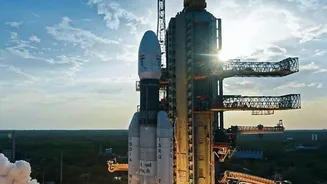
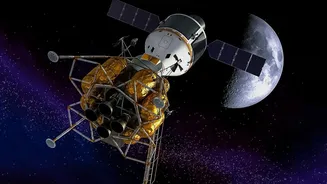
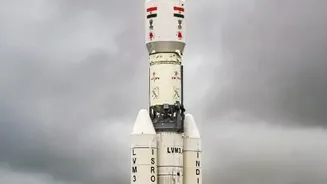
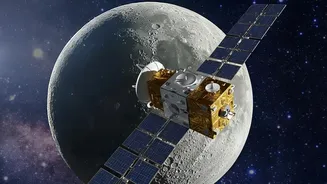
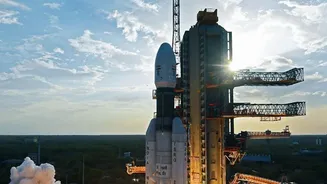
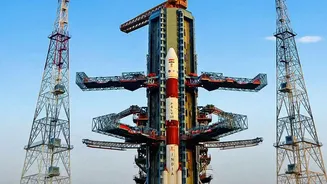
At the heart of Chandrayaan-4 is a highly complex, five-module spacecraft. Due to its immense weight—estimated around 9,200 kg in total—the system is too heavy for a single LVM3 rocket, India's most powerful launch vehicle. Instead, ISRO plans an innovative dual-launch strategy. Two separate LVM3 rockets will launch the mission's components in two stacks. The first stack will contain the Descender Module (the lander) and the Ascender Module (the vehicle that will lift off from the Moon). The second will carry a Propulsion Module (for the journey to the Moon), a Transfer Module, and a Re-entry Module (to bring the sample home). These two stacks will then meet and dock in Earth's orbit—a crucial manoeuvre in itself—before beginning the long journey to the Moon.
The Journey: Landing, Collecting, and Lifting Off
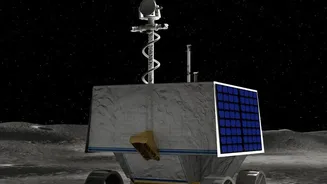
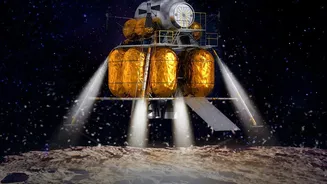
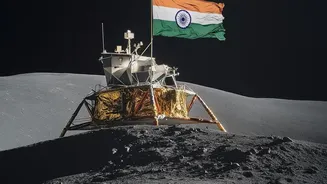
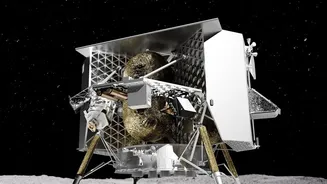
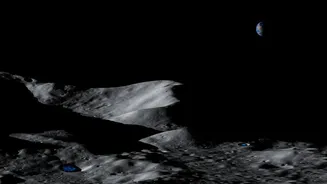
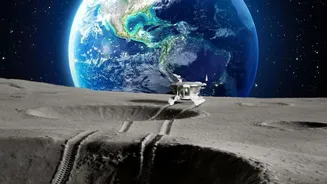
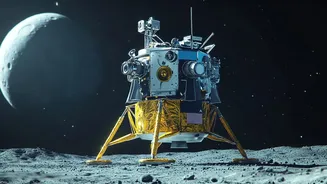
Once the integrated spacecraft reaches lunar orbit, the Descender and Ascender modules will separate and make a soft landing near the Moon's south pole, a region of immense scientific interest. After landing, a robotic arm on the Descender will collect surface samples, while a drill will gather subsurface material. These precious samples, expected to total around 2-3 kg, will be transferred and sealed inside the Ascender Module. Then comes one of the mission's most critical moments: the Ascender will fire its engine, using the Descender as a launchpad to lift off from the lunar surface and return to orbit. This will be the first time ISRO has ever launched a vehicle from another celestial body.
The Intricate Return Trip
In lunar orbit, another delicate operation will unfold. The Ascender Module, carrying the lunar soil, will autonomously rendezvous and dock with the Transfer Module. The sample container will be moved from the Ascender into the Re-entry Module for the trip home. With the sample secured, the Transfer Module will fire its engines to exit lunar orbit and set a course for Earth. As it approaches our planet, the Re-entry Module will separate and plunge through the atmosphere at incredibly high speeds. Designed to withstand extreme temperatures, it will perform a ballistic re-entry before landing safely on Earth, delivering its priceless cargo to eager scientists.
Why Bring Lunar Samples to Earth?
While rovers and landers can perform amazing science on the Moon, the instruments they carry are limited by size and power. Bringing samples back to Earth allows scientists to use the full power of terrestrial laboratories, with equipment far too large or delicate to ever be sent to space. These samples can be studied for decades, answering new questions with new technologies that haven't even been invented yet. By collecting material from the geologically diverse and largely unexplored south pole, Chandrayaan-4 could provide unprecedented insights into the Moon's origin, the history of our solar system, and the potential for resources like water ice, which could support future human exploration. The mission is a crucial stepping stone for India's long-term vision of landing astronauts on the Moon by 2040.