

Meet S/2023 U1
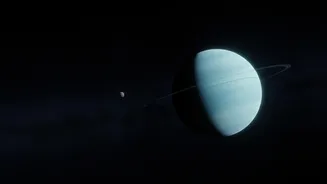
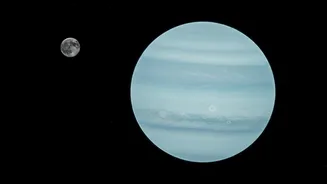
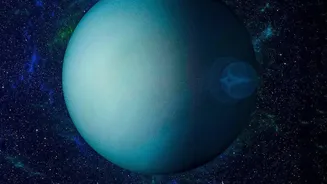
Scientists recently confirmed the existence of a new moon orbiting Uranus, provisionally named S/2023 U1. Discovered using powerful ground-based telescopes like the Magellan telescope in Chile, this isn't a giant, obvious satellite. In fact, at an estimated
8 kilometres in diameter, it’s likely the smallest of Uranus's known moons, which is why it eluded detection for so long. To spot it, astronomers had to use advanced image processing techniques, layering multiple long-exposure images to make the faint dot of light appear against the background of distant stars. Its discovery in late 2023, announced in early 2024, brought the planet's official moon count to 28.
A Wild and Unusual Path
The most captivating thing about S/2023 U1 isn't its size, but its journey around Uranus. Unlike the planet's larger, more well-behaved moons that follow relatively flat, circular paths, this little one is an 'irregular moon'. Its orbit is highly eccentric, meaning it’s stretched out into a long ellipse rather than a neat circle. It’s also extremely inclined, travelling at a steep angle compared to Uranus’s equatorial plane. To complete one of these looping, tilted orbits takes this tiny moon a staggering 680 Earth days. Furthermore, its orbit is retrograde, meaning it travels in the opposite direction to Uranus's own rotation, a clear sign that it’s not from around here.
A Captured Wanderer
Moons with such distant, eccentric, and inclined orbits are believed to be 'captured' objects. They didn't form from the same disk of gas and dust that created Uranus and its larger, 'regular' moons millions of years ago. Instead, S/2023 U1 was likely a free-floating object, perhaps originating from the Kuiper Belt, that wandered too close to the ice giant. Getting captured isn't easy; an object usually needs to lose energy somehow, perhaps through gravitational interaction with another object or friction from a primordial gas cloud. The strange orbit of S/2023 U1 is a tell-tale fingerprint of this chaotic capture process, a relic from the solar system's turbulent youth.
Clues to a Chaotic Past
So why does one tiny, oddball moon matter so much? Because it provides a physical clue about the history of our solar system. The existence of captured moons like S/2023 U1 helps astronomers refine their models of how the giant planets migrated and shaped their environments. Its orbit also places it within a 'group' of other irregular moons, like Caliban and Stephano, that have similar paths. This suggests they might all be fragments of a single, larger parent body that was captured by Uranus and later shattered in a collision with a comet or asteroid. Each new discovery helps piece together this violent, dynamic puzzle, revealing that the solar system was once a much messier place.
The Hunt Continues
Finding S/2023 U1 proves that even in our own cosmic backyard, major discoveries are still waiting to be made. The techniques used to find it are pushing the boundaries of what ground-based telescopes can achieve. As technology improves, and with powerful instruments like the James Webb Space Telescope turning their gaze on the outer planets, astronomers expect to find more of these faint, distant satellites. Each one, no matter how small, offers another piece of evidence to help us understand the grand story of how our planetary system came to be, from its orderly giants to its tiniest, most unruly moons.