




A Day Longer Than a Year
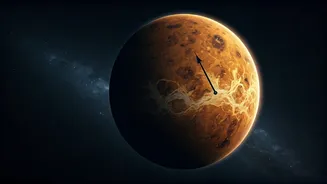
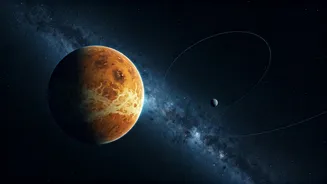
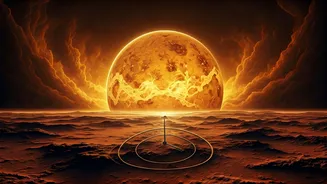
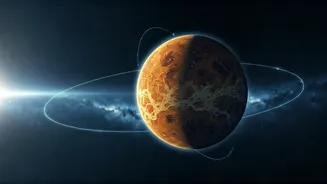
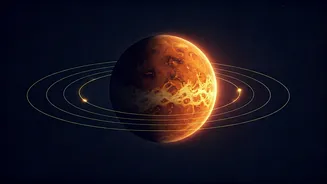
It sounds like a riddle, but it’s a simple, mind-bending fact. A 'year' is the time it takes a planet to complete one orbit around the Sun. For Venus, this journey takes about 225 Earth days. A 'day' is the time it takes for a planet to complete one full
rotation on its axis. For Venus, this takes a staggeringly long 243 Earth days. So, yes, a single day on Venus is longer than a Venusian year. If you could stand on its surface, the planet would complete its entire trip around the Sun before it finished a single spin. This makes Venus a true oddball in our cosmic neighbourhood, a planet that plays by its own bizarre set of rules.
Not Just Slow, But Backwards
The oddities don’t stop there. Venus also spins in the opposite direction to most other planets in the solar system, including Earth. This is known as retrograde rotation. While on Earth we watch the Sun rise in the east and set in the west, on Venus it would rise in the west and set in the east. Only one other major planet, Uranus (which is tilted on its side), shares this peculiar characteristic. This backward spin, combined with its orbit, has another strange effect. While its rotational day (a sidereal day) is 243 Earth days, the time from one sunrise to the next (a solar day) is much shorter, around 117 Earth days. This is because as Venus slowly rotates backwards, it’s also moving forward in its orbit around the Sun, effectively 'catching up' with the Sun's position in its sky more quickly.
Why the Bizarre Rotation?
Scientists don't have a single definitive answer for Venus's strange spin, but there are two leading theories. The first involves a colossal impact in the distant past. Billions of years ago, during the chaotic formation of the solar system, Venus might have been struck by a massive planet-sized object. Such an impact could have had enough force to not only halt its original rotation but actually reverse it, leaving it with the slow, backward spin we see today. The second major theory points to Venus's incredibly thick atmosphere. This dense ocean of carbon dioxide, 90 times thicker than Earth’s, creates immense friction and powerful atmospheric tides. Over billions of years, the gravitational pull of the Sun on this heavy atmosphere could have acted like a brake, slowing down the planet's rotation and eventually flipping it into a stable, retrograde state.
A World Shaped by Its Spin
This incredibly slow rotation has profound consequences for the planet's environment. With each side of the planet facing the Sun for nearly two Earth months at a time, the surface bakes to unimaginable temperatures. Venus is the hottest planet in the solar system, with an average surface temperature of around 465 degrees Celsius — hot enough to melt lead. The long days and nights fail to create any cooling effect. Instead, the thick, toxic atmosphere traps heat in a runaway greenhouse effect, distributing it across the entire planet. Even the night side of Venus remains scorching hot. This extreme, uniform heat, driven by the planet’s sluggish rotation and thick atmosphere, has created a truly hellish landscape unlike anything on Earth.