



A New, Wider Window on the Universe
Imagine trying to take a panoramic picture of a mountain range by stitching together thousands of tiny photos taken through a keyhole. That, in essence, is what telescopes like Hubble have been doing for decades. They provide incredible, deep detail but
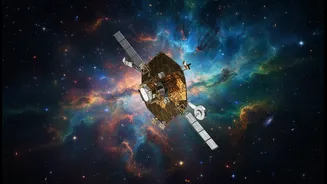
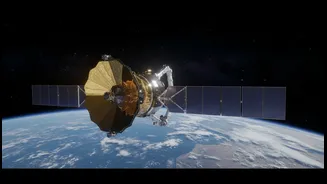
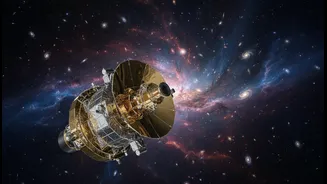
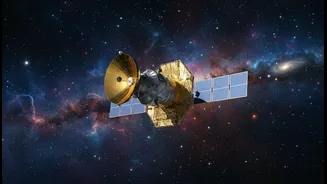
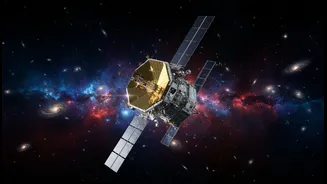
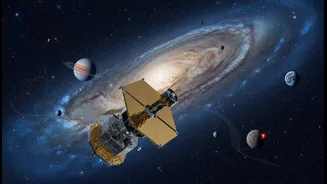
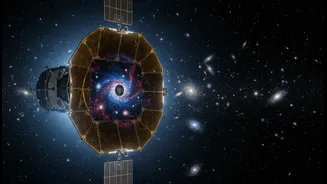
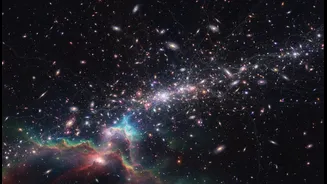
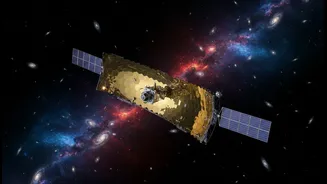
in a very narrow view. The Nancy Grace Roman Space Telescope changes the game. While its 2.4-metre mirror is the same size as Hubble's, its Wide Field Instrument gives it a field of view at least 100 times larger. This means it can map vast swathes of the sky with the same sharp resolution, but up to 1,000 times faster than its predecessors. Scheduled to launch on August 30, 2026, aboard a SpaceX Falcon Heavy, Roman has already arrived at Kennedy Space Center for its final launch preparations. This panoramic power is what allows it to conduct massive surveys that are crucial for understanding the universe on a grand scale.
Hunting for the Universe's Invisible Scaffolding
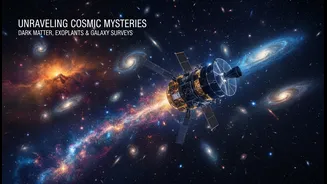
One of Roman’s primary targets is something we can’t see at all: dark matter. This mysterious substance makes up about 85% of the matter in the universe, yet it doesn’t emit or reflect light. Scientists know it exists because of its gravitational pull on the things we can see. Roman will map the universe's dark matter by observing a phenomenon called weak gravitational lensing. As light from distant galaxies travels to us, its path is slightly bent by the gravity of any matter it passes, including clumps of dark matter. This bending subtly distorts the apparent shapes of the galaxies. By surveying millions of galaxies, Roman will create a vast map of these distortions, revealing the invisible dark matter structure and helping scientists test theories about how galaxies and cosmic structures formed under its influence.
Finding Worlds by a Gravitational Quirk
Roman is also poised to revolutionize the hunt for exoplanets, planets outside our solar system. Its main technique is a powerful method called gravitational microlensing. This occurs when a star with a planet randomly aligns with a much more distant star from our point of view. The gravity of the foreground star acts like a lens, magnifying the light from the background star. If the foreground star has a planet, the planet's own gravity adds a distinct, extra blip to the magnified light. Because Roman will be staring at a dense field of 100 million stars toward the center of our galaxy for long periods, it's expected to detect thousands of these microlensing events, discovering an estimated 2,500 new worlds—including planets smaller than Mars.
Taking Direct Pictures of Giant Planets
Beyond microlensing, Roman carries a groundbreaking technology demonstrator called the Coronagraph Instrument. A coronagraph is essentially a high-tech starshade, designed to block the overwhelming glare of a star so that the faint light of an orbiting planet can be seen directly. Taking a direct image of an exoplanet is incredibly difficult, like spotting a firefly next to a searchlight. Roman's coronagraph will be the first 'active' one in space, using deformable mirrors with thousands of tiny pistons to actively cancel out stray starlight. This will allow it to image Jupiter-sized planets in reflected light, a crucial step toward the ultimate goal of future telescopes: directly imaging Earth-like planets and analyzing their atmospheres for signs of life.
What the Discoveries Will Decide
The headline's 'real decisions' refer to how Roman's data will settle fundamental debates in astronomy. The three major surveys—dark matter mapping, exoplanet hunting, and galaxy evolution studies—are deeply interconnected. By creating a 3D map of millions of galaxies, Roman will track how the universe's expansion has changed over time, providing the most precise measurements yet of the mysterious dark energy that drives this acceleration. Its massive exoplanet census will give us a statistical picture of what other solar systems are like, telling us how common or rare our own cosmic neighborhood is. These vast datasets will allow scientists to choose between competing theories of cosmology and planet formation, deciding which models best fit reality. In essence, Roman's observations will help write the next chapter of our cosmic story and tell other observatories, like the James Webb Space Telescope, where to look next for even more detailed discoveries.