




The Challenge of Rigid Plans
Traditionally, space missions were designed like intricate clockwork. Every objective, every manoeuvre, and every scientific measurement was planned years in advance. This monolithic approach, while thorough, has a critical weakness: it leaves little
room for surprises. A single component failure or an unexpected discovery could jeopardise the entire mission. If the target asteroid turned out to be less interesting than hoped, or a key instrument failed, the massive investment of time and resources could yield disappointing results. This rigidity meant missions were often a high-risk, all-or-nothing gamble, where adapting to new information mid-flight was nearly impossible.
A New Philosophy: Modular Design
Modular science planning flips that script. Instead of a single, unchangeable plan, it treats a mission like a toolkit of capabilities. By designing spacecraft with independent, adaptable components and flexible objectives, agencies can make decisions on the fly. Think of it less like a detailed screenplay and more like improvisational theatre with a set of known characters and props. This approach means a spacecraft can be built with redundancies and multiple mission options from the start. If one instrument fails, another can be prioritised. If a primary goal is achieved ahead of schedule and the spacecraft is still healthy, new targets can be chosen. This strategy is about building resilience and maximising scientific return on investment.
Hayabusa2: A Masterclass in Adaptability
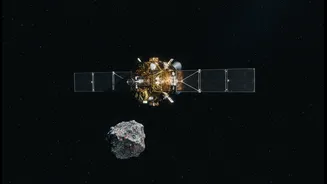
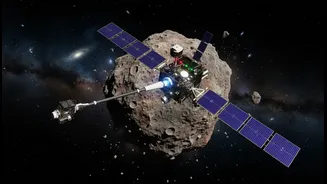
JAXA's Hayabusa2 mission is the poster child for this philosophy. Launched in 2014, its primary goal was to reach the asteroid Ryugu, collect samples, and return them to Earth. But its design was brimming with modular potential. The mission successfully deployed multiple small rovers to explore the surface and even fired an impactor to create an artificial crater, allowing it to collect pristine subsurface material—a feat never before accomplished. These were complex, high-risk manoeuvres that added immense scientific value, building on the successes of its predecessor, Hayabusa. After completing all its primary tasks at Ryugu, the spacecraft successfully delivered its precious 5.4-gram sample capsule to Earth in December 2020.
The Payoff: An Unexpected Second Act
Here's where the modular planning truly paid off. After dropping off its samples, the Hayabusa2 spacecraft was still perfectly functional with about half of its xenon fuel remaining. Instead of being decommissioned, JAXA initiated an ambitious extended mission. Thanks to its robust and adaptable design, mission planners charted a new, decade-long course. In July 2026, the explorer performed a flyby of the asteroid 2001 CC21. It is now en route to a 2031 rendezvous with 1998 KY26, a tiny, rapidly spinning asteroid only about 30 meters in diameter. This extended journey turns one highly successful mission into three, exploring celestial bodies of different types and providing invaluable data for planetary defence.
The Future is Flexible
The success of Hayabusa2 is not an isolated incident; it's a blueprint for the future of space exploration. Designing for longevity and adaptability is becoming a core principle for agencies worldwide. This approach minimises risk and multiplies scientific opportunities without the prohibitive cost of launching entirely new missions. It allows scientists to be more like explorers and less like machine operators, reacting to the universe as they find it. As humanity sets its sights on more complex targets like Jupiter's moons or returning to our own Moon, the lessons from JAXA's clever planning will be essential. The ability to pivot, improvise, and seize unexpected opportunities is what will define the next era of discovery.