
The Sun's Inevitable Finale
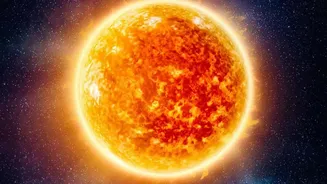
Every star has a life cycle, and our Sun is no different. For the last 4.6 billion years, it has been in its stable main-sequence phase, fusing hydrogen into helium in its core. This process creates the light and heat that sustains our solar system. But
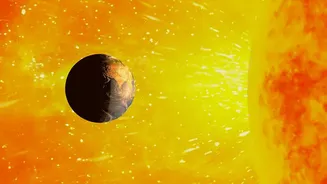
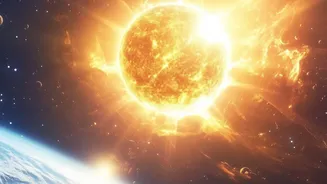
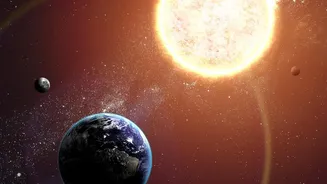
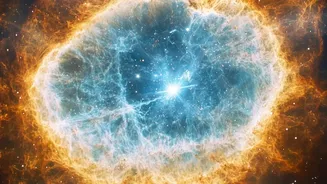
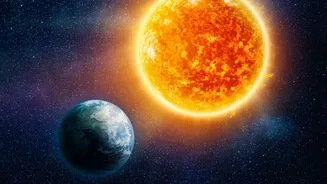
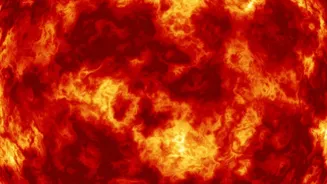
this fuel is finite. In roughly another five billion years, the hydrogen will run out. Without the outward pressure from fusion to counteract its own immense gravity, the Sun's core will contract and heat up, while its outer layers will expand dramatically. It will transform into a red giant, swelling to potentially 100 times its current size and likely engulfing the inner planets: Mercury, Venus, and possibly even Earth. After this violent phase, which may last a billion years, the Sun will shed its outer layers, leaving behind an incredibly dense, Earth-sized core known as a white dwarf.
A Perilous Journey for the Planets
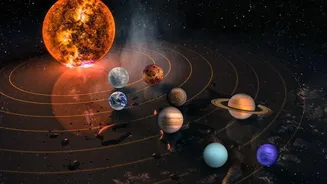
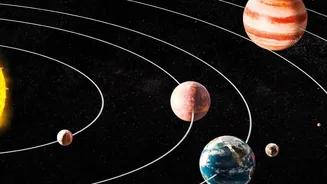
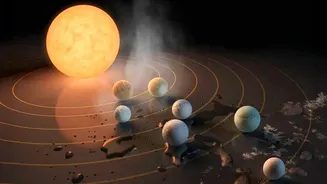
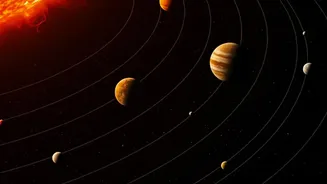
The Sun's death march will be a chaotic time for the entire solar system. While the inner planets face near-certain destruction, the outer gas and ice giants—Jupiter, Saturn, Uranus, and Neptune—face a different set of challenges. As the Sun expands into a red giant, its habitable zone will shift outward, briefly warming the icy moons of Jupiter and Saturn. These worlds, like Europa, could experience a 'false summer' as their ice melts, though this period would be temporary. The more significant change comes as the Sun sheds nearly half its mass. With its gravitational pull significantly weakened, the orbits of the surviving planets will expand. Jupiter, for instance, could drift into an orbit nearly twice its current distance from the stellar core. While most simulations predict the giant planets will survive, this gravitational shift could destabilize the whole system, potentially ejecting smaller bodies or even one of the ice giants into interstellar space.
Clues from Distant Star Systems
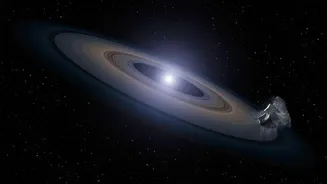
How can we be so sure about this distant future? Astronomers look for clues by studying stars that have already completed this process. They observe white dwarfs across our galaxy, looking for signs of surviving planetary systems. For years, they've found white dwarfs 'polluted' with heavy elements like calcium and iron, which should have sunk into the star's dense interior. This pollution is seen as forensic evidence of asteroids and other rocky bodies being torn apart and consumed by the white dwarf, likely nudged inward by the gravity of surviving outer planets. More directly, astronomers have now discovered giant planets orbiting white dwarfs. One famous example, known as WD 1856 b, is a Jupiter-sized world that survived its star's death, offering a direct preview of what Jupiter's own future might look like. These discoveries confirm that it is indeed possible for large planets to endure their star's violent end.
Our Solar System's Next Chapter
Applying these cosmic lessons to our own home, scientists are confident that Jupiter, Saturn, Uranus, and Neptune will remain orbiting our Sun long after it becomes a white dwarf. They are simply too large and too distant to be swallowed or boiled away during the red giant phase. Their new, wider orbits will carry them through a much darker and colder solar system, illuminated only by the faint glow of the cooling white dwarf. The solar system will become a quiet, ghostly place. For eons, these giant worlds will continue their slow journey around the stellar ember that was once our brilliant Sun. Over immense timescales, even these stable orbits could be disrupted by a passing star, which could scatter the remaining planets. But for billions of years after the Sun's death, our giant planets are expected to persist as the solar system's last great survivors.