






Beyond the Robot Takeover Myth
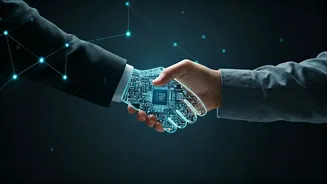
Forget the dramatic headlines about robots replacing every job. The reality of AI's impact is far more nuanced and, for the prepared, far more exciting. In India’s thriving tech and service economy, AI is not primarily about replacing humans but augmenting
them. Think of it as the ultimate assistant—a tool that can analyse massive datasets in seconds, automate repetitive tasks, and free up human workers to focus on what they do best: strategy, creativity, and complex problem-solving. This shift means that while some routine jobs may evolve or disappear, a whole new ecosystem of roles is emerging. These are jobs that leverage AI's power, requiring a partnership between human ingenuity and machine intelligence. The future isn't human versus machine; it's human *with* machine.
The New Job Titles on the Block
Ten years ago, roles like 'Prompt Engineer' or 'AI Ethics Officer' sounded like science fiction. Today, they are among the fastest-growing and highest-paying jobs in the tech sector. An AI/ML Engineer, for example, doesn't just write code; they design and build the intelligent systems that power everything from recommendation engines on streaming sites to fraud detection in banking. A Prompt Engineer specialises in crafting the perfect questions to get the most accurate and useful responses from generative AI models like ChatGPT. Meanwhile, an AI Ethics Officer ensures that these powerful technologies are developed and deployed responsibly, without bias or unintended harm. These roles highlight a key trend: the new jobs are not just technical but also require deep domain knowledge and strong critical thinking skills.
It's Not Just for Techies Anymore
One of the biggest misconceptions is that the AI revolution is only relevant to software developers. Nothing could be further from the truth. AI is becoming a horizontal enabler across all industries. In marketing, professionals use AI to analyse consumer behaviour and personalise campaigns at a scale never before possible. In healthcare, radiologists are using AI-powered tools to help detect diseases earlier and more accurately from scans. In agriculture, AI helps farmers optimise crop yields using data on weather patterns and soil health. Even creative fields are being transformed. Writers use AI for research and brainstorming, while designers use generative tools to create initial concepts. The core message is clear: whatever your field, understanding how to leverage AI will soon become a fundamental part of your job.
The Essential Skills for an AI-Powered World
So, how do you prepare for this new reality? It comes down to cultivating a mix of 'hard' and 'soft' skills. On the hard skills side, foundational knowledge of data literacy is non-negotiable. Understanding how data is collected, interpreted, and used to train AI models is crucial. For those in technical roles, proficiency in languages like Python and familiarity with machine learning frameworks are essential. However, soft skills are becoming even more important differentiators. These include: * **Critical Thinking:** The ability to question an AI's output, identify potential biases, and use the information wisely. * **Creativity:** AI can execute, but it needs human creativity to provide the initial spark and direction. * **Emotional Intelligence:** In a world of automation, skills like empathy, communication, and collaboration become premium assets. * **Adaptability and a 'Learn-it-All' Mindset:** Technology will change, but the ability to continuously learn and adapt will always be in demand.
Your Action Plan: How to Get Started Today
The prospect of upskilling can feel daunting, but the resources available today make it more accessible than ever. Platforms like Coursera, edX, and upGrad offer specialised courses from top universities and companies on everything from introductory AI concepts to advanced machine learning. Government and industry bodies in India, like NASSCOM with its FutureSkills Prime platform, are actively promoting digital literacy and providing subsidised training. Don't just take courses—apply your knowledge. Start a small project, contribute to an open-source AI project, or simply experiment with free AI tools to understand their capabilities and limitations. Building a portfolio of practical experience is often more valuable to employers than a certificate alone. The key is to start now, stay curious, and embrace the learning process.