
The Challenge of an Extreme World
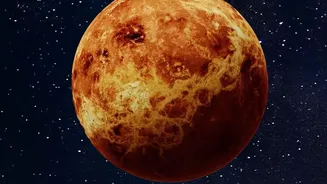
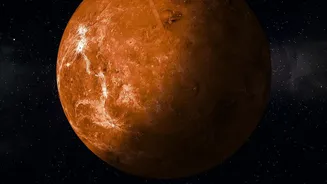
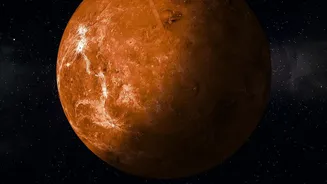
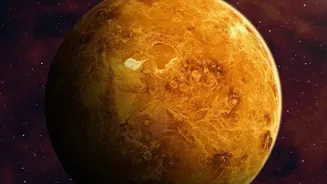
Before understanding how Shukrayaan will study Venus, it’s crucial to appreciate the sheer hostility of the planet. Its surface temperature is a staggering 460°C, hot enough to melt lead, and the atmospheric pressure is over 90 times that of Earth's.
The planet is perpetually covered by thick, corrosive clouds of sulphuric acid that race around the planet at high speeds and make it impossible to see the surface with conventional cameras. These very clouds are a primary scientific target. Scientists want to understand their structure, composition, and dynamics to figure out why Venus, a planet so similar in size and mass to Earth, suffered a runaway greenhouse effect that made it so inhospitable. Answering this question could provide vital insights into Earth's own climate evolution.
Piercing the Veil with Radar
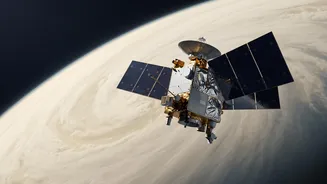
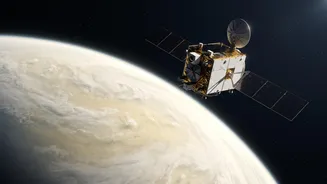
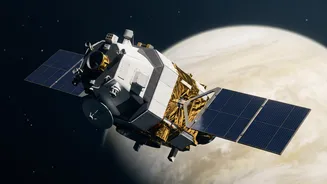
The most formidable obstacle at Venus is its opaque cloud cover. To overcome this, Shukrayaan's flagship instrument is a high-resolution Synthetic Aperture Radar (SAR). Unlike an optical camera that relies on light, a radar sends out its own radio waves and analyses the echoes that bounce back. These waves can penetrate the thick clouds to map the hidden surface below. Shukrayaan's SAR is designed to investigate Venus's surface and subsurface geology, searching for clues about its volcanic past and present. It is expected to provide images with a resolution up to four times better than NASA's Magellan mission in the 1990s, offering an unprecedentedly detailed look at the planet's terrain.
Decoding the Atmosphere's Chemical Fingerprints
While the radar peels back the clouds to see the ground, a suite of other instruments will focus on the clouds themselves. The primary tool for this is the Venus Infrared Atmospheric Gases Linker (VIRAL), a collaborative instrument developed with Russia and France. VIRAL is a spectrometer, a device that analyses light by splitting it into its constituent colours or wavelengths. By studying the sunlight that passes through Venus's atmosphere during solar occultation (when the spacecraft flies behind the planet), VIRAL can detect the unique chemical 'fingerprints' of different gases. Its main goal is to measure the vertical distribution of key gases like carbon dioxide and sulphur dioxide, and to study the composition of the cloud particles themselves.
The Hunt for Elusive Molecules
Beyond the main atmospheric components, Shukrayaan is equipped to search for trace gases that could hold exciting clues. Following a debated discovery of phosphine gas in Venus's clouds in 2020, scientific interest in the planet's upper atmosphere has surged. On Earth, phosphine is associated with biological processes, so its potential presence on Venus raises tantalising questions about the possibility of microbial life in the more temperate cloud layers. The VIRAL instrument is capable of searching for phosphine, which could help confirm or refute its presence and provide context for this intriguing possibility. Other instruments, like the Venus Surface Emissivity and Atmospheric Mapper (VSEAM), will also study the atmosphere, looking for volcanic hotspots and mapping water vapour.
Understanding the Solar Connection
A planet's atmosphere doesn't exist in isolation; it constantly interacts with the Sun. Shukrayaan will carry instruments to study this relationship. Payloads developed in collaboration with Sweden and Germany, such as VISWAS and RAVI, will analyse how the solar wind—a stream of charged particles from the Sun—interacts with Venus's ionosphere, the upper charged layer of its atmosphere. Unlike Earth, Venus lacks a global magnetic field to protect it, so this interaction is much more direct and is a key factor in how the planet has lost its atmosphere over billions of years. Instruments like the VEnus THermosphere Ionosphere composition Analyser (VETHICA) will directly 'sniff' the particles in this region to understand its composition and dynamics.