


Beyond Stargazing: What Is Space Weather?
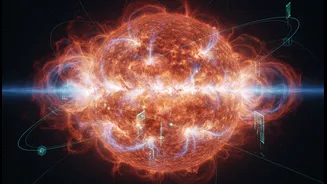
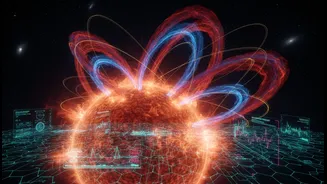
Space weather refers to the changing conditions in space, driven primarily by the Sun. Unlike weather on Earth, it doesn't involve wind and rain. Instead, it’s about the constant stream of charged particles and energy flowing from the Sun, known as the solar
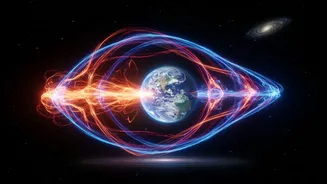
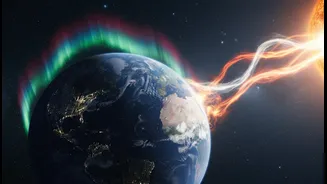
wind. Occasionally, massive explosions on the Sun, like solar flares and Coronal Mass Ejections (CMEs), hurl vast amounts of plasma and radiation into space. When these events are directed at Earth, they interact with our planet's magnetic field and upper atmosphere, creating phenomena that can have significant effects. Think of it as the difference between a calm stellar breeze and a cosmic hurricane. These are not just beautiful light shows like the aurora; they are powerful events with real-world consequences.
A Threat to Our Tech-Reliant World
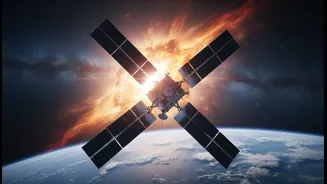
Our modern society is deeply vulnerable to space weather. These solar outbursts can disrupt and damage the technologies we rely on daily. Severe space weather can disable satellites by damaging their electronics, cause them to lose altitude due to increased atmospheric drag, and interfere with their communication signals. This directly impacts services like GPS navigation, which is crucial for aviation, shipping, and even farming. On the ground, geomagnetic storms can induce powerful currents in power grids, potentially damaging transformers and causing widespread blackouts. Furthermore, high-frequency radio communications used by airlines and government agencies can be completely blacked out. As our dependence on technology grows, so does the need to predict and mitigate these solar threats.
The Rise of the Space Weather Forecaster
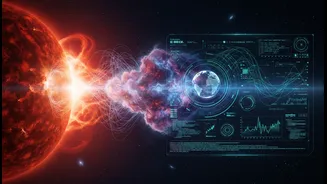
This is where applied astronomy comes in. An entire professional field has emerged dedicated to monitoring the Sun, predicting its activity, and forecasting its impact on Earth. These professionals, often called space weather forecasters or heliophysicists, are like meteorologists for space. They analyze data from solar observatories and satellites to issue warnings and advisories to industries that could be affected. It's a field of 'applied' science because it takes fundamental knowledge of physics and astronomy and uses it to solve practical, real-world problems. Specialists in this area are needed at space agencies, aviation authorities, power companies, and satellite operators to help protect critical infrastructure.
Your Career Path in Applied Astronomy
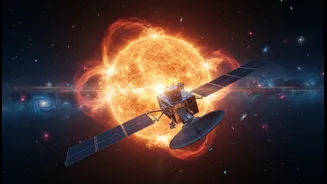
For students passionate about space but also seeking a defined career path, space weather offers tremendous opportunities. India, with its growing space program, is a key player. The Indian Space Research Organisation (ISRO) is heavily invested in this area, notably with its Aditya-L1 mission—India's first dedicated solar observatory. This mission is designed to study the Sun's dynamics and provide crucial data for space weather analysis. Careers in this domain include roles like research scientist, data analyst, and satellite operations specialist. Professionals are employed by government bodies like ISRO, research institutions such as the National Atmospheric Research Laboratory (NARL), and a growing number of private-sector space and technology companies.
Building Your Skills in India
To enter this field, a strong foundation in science and maths is essential. A bachelor's degree in physics, astrophysics, or a related engineering field is the typical starting point. Aspiring space weather scientists should focus on developing strong analytical skills and proficiency in programming languages like Python or MATLAB, which are used for data analysis and modeling. Many roles, especially in research, require a master's degree or a PhD. Indian institutions like the Indian Institutes of Science Education and Research (IISERs), the Indian Institute of Astrophysics (IIA), and various IITs offer robust programs in physics and astronomy that can pave the way for a career in this exciting field.