


Our Standard Cosmic Story
Our current understanding of the universe's history is called the Lambda-CDM model. It's been incredibly successful, explaining everything from the cosmic microwave background (CMB)—the faint afterglow of the Big Bang—to the way galaxies cluster together.
This model is how scientists arrived at the 13.8 billion-year age. By studying the CMB, which is like a snapshot of the infant universe, astronomers can calculate how fast it has been expanding ever since and wind the clock back to the beginning. For a long time, this picture, derived from the early universe, has been the bedrock of cosmology.
A Tale of Two Universes
The problem, known as the 'Hubble Tension', is that there is more than one way to measure the universe's expansion. While the CMB method looks at the early universe, another method examines the 'local' or modern universe. This involves measuring the distances to nearby objects with known brightness, like Cepheid variable stars and Type Ia supernovae, to see how fast they are receding from us. For years, these local measurements have consistently suggested a faster rate of expansion. A faster expansion means a shorter journey from the Big Bang to now, implying a younger universe, perhaps closer to 12.5 billion years old. This disagreement has grown from a minor curiosity into a significant crisis as measurement tools have become more precise.
New Evidence Stirs the Pot
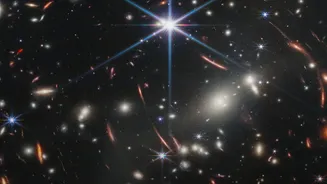
Enter the James Webb Space Telescope (JWST). Its powerful infrared eyes are peering back to the cosmic dawn, observing some of the earliest galaxies ever formed. What it has found is puzzling: some of these early galaxies appear surprisingly large, mature, and chemically enriched. According to the standard 13.8 billion-year timeline, these galaxies shouldn't have had enough time to grow so massive or produce so many heavy elements. This has led some scientists to question the timeline itself. One radical new model, proposed by researchers at the University of Ottawa and called CCC+TL, suggests the universe could be as old as 26.7 billion years. This would easily allow for the formation of these advanced early galaxies.
Is Our Cosmic Model Broken?
While the idea of a universe twice as old is headline-grabbing, most scientists are more cautious. They point out that the advanced galaxies seen by JWST might not mean the age is wrong, but that our theories of early galaxy formation are incomplete. Perhaps galaxies formed faster or more efficiently than we thought. However, the Hubble Tension remains a stubborn problem, with recent independent measurements confirming the discrepancy. The ongoing disagreement between the early and local universe measurements suggests that something fundamental might be missing from our standard model. The possibilities range from a new type of 'early dark energy' that influenced the initial expansion, to the idea that fundamental physical constants have changed over time.