




The Dream of a Cosmic GPS
For decades, navigating deep space has been a meticulous process, requiring constant communication with Earth. Spacecraft rely on the Deep Space Network, a system of massive Earth-based antennas, to determine their position and trajectory. This method
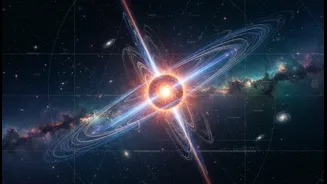
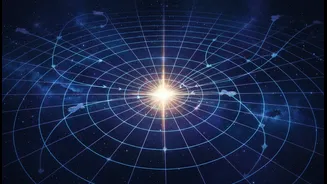
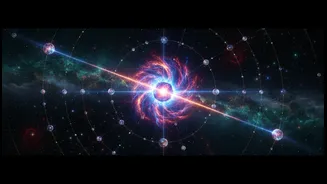
is incredibly precise but also slow and resource-intensive, creating a communications bottleneck as we send more missions into the solar system. The solution is autonomous navigation. The leading concept, known as X-ray Pulsar-based Navigation and Timing (XNAV), aims to use the regular, predictable signals from pulsars—rapidly spinning neutron stars—to create a galactic positioning system, much like how GPS uses satellites. NASA's work on projects like the Lighthouse Pulsar Map is designed to make this science-fiction concept a reality, enabling spacecraft to know where they are without phoning home.
Nature's Most Precise Clocks
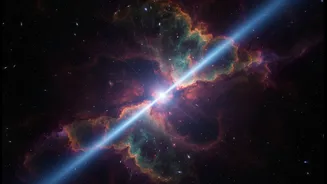
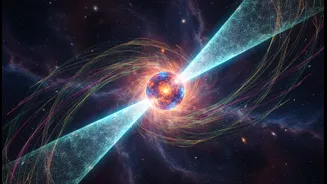
Pulsars are the incredibly dense, collapsed cores of massive stars. Some spin hundreds of times per second, emitting beams of radiation from their magnetic poles. As they rotate, these beams sweep across the cosmos like a lighthouse beacon. From Earth, we detect these beams as pulses with a regularity that can rival atomic clocks. It is this precise timing that makes them so valuable for navigation. By equipping a spacecraft with a small X-ray telescope and a database of known pulsars, it could theoretically measure the arrival times of pulses from several different pulsars to triangulate its position anywhere in space with an accuracy of within a few kilometers.
The Interstellar Magnetic Haze
The path from a distant pulsar to a spacecraft is not empty. The space between stars, known as the interstellar medium, is filled with gas, dust, and pervasive magnetic fields. While X-rays are less affected by this medium than radio waves, these magnetic fields are not uniform. They are a turbulent, complex web that can influence the path and properties of the pulsar's signal, however subtly. For a navigation system that depends on timing signals down to the microsecond, understanding and accounting for these magnetic fields is not just a detail—it's a fundamental requirement. An unmapped magnetic field could introduce tiny errors that, over the vast distances of space, could send a spacecraft significantly off course.
The Challenge of Model Interpretation
This is where the core challenge lies. We cannot directly measure every wisp and whorl of a magnetic field across light-years of space. Instead, scientists rely on creating complex computer models to interpret the data they can gather. Recent observations of the Lighthouse Nebula, for example, used NASA's IXPE telescope to measure the polarization of X-rays, which provides clues about the magnetic field's direction and structure. However, these measurements provide data points, not a complete picture. Scientists must interpret this data through models that make certain assumptions about physics under extreme conditions. The results from the Lighthouse Nebula were surprising, showing lower turbulence than models predicted and revealing that X-ray and radio observations suggested different magnetic field orientations, hinting at far more complex processes at work.
From Limitation to Innovation
The headline's "key limit" is not a dead end, but a frontier of scientific inquiry. The discrepancy between models and recent observations shows that our understanding of pulsar magnetospheres and the interstellar medium is incomplete. This limitation pushes scientists to develop more sophisticated models, create new analytical techniques to squeeze more information out of faint signals, and design better instruments. Researchers are constantly refining their understanding of how magnetic fields evolve and affect pulsar timing. Overcoming this hurdle is crucial not only for the future of autonomous deep space navigation but also for fundamental physics. Each pulsar and its surrounding nebula is a natural laboratory for studying matter and energy under conditions impossible to create on Earth.