





What Exactly Was CAPSTONE?
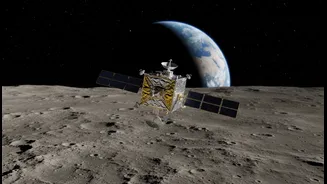
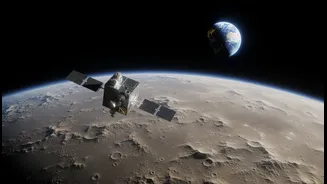
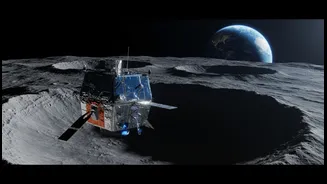
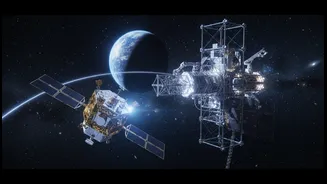
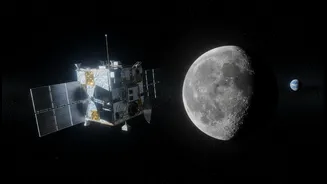
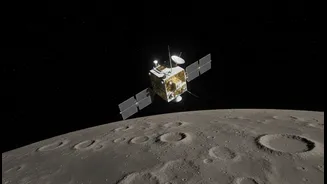
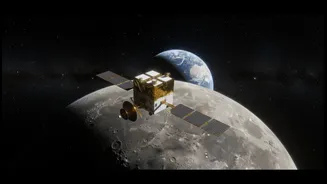
CAPSTONE is an acronym for the Cislunar Autonomous Positioning System Technology Operations and Navigation Experiment. Launched in June 2022, this 55-pound (25 kg) CubeSat was a low-cost pathfinder mission designed to support NASA's ambitious Artemis
program, which aims to establish a sustained human presence on the Moon. Owned and operated by the commercial company Advanced Space for NASA, CAPSTONE’s primary job was to be a trailblazer, testing a unique and untried lunar orbit and demonstrating new navigation technologies far from home. Think of it not as the main event, but as the crucial scout that mapped the treacherous path ahead for much larger, more expensive missions to follow.
The Groundbreaking Orbit
The centerpiece of the mission was its destination: a Near-Rectilinear Halo Orbit (NRHO). This is not your typical, simple circle around the Moon. The NRHO is a highly elliptical, carefully balanced orbit that uses the gravitational pull of both the Earth and the Moon to maintain stability. A spacecraft in this orbit passes close to one lunar pole before swinging out far beyond the other, requiring minimal fuel for long-term station keeping. CAPSTONE became the very first spacecraft to successfully enter and operate in this specific orbit, proving its viability. This was a critical risk-reduction step for NASA's planned Lunar Gateway, an orbiting outpost that will use the same NRHO to serve as a staging point for astronauts traveling to and from the lunar surface.
A New GPS for the Moon
Beyond testing the orbit, CAPSTONE's other major goal was to demonstrate a new form of autonomous navigation. Currently, spacecraft in deep space rely on constant communication with giant antennas on Earth to know where they are. CAPSTONE tested the Cislunar Autonomous Positioning System (CAPS), a new technology designed to allow spacecraft to determine their position without Earth-based tracking. It did this by communicating directly with NASA's Lunar Reconnaissance Orbiter (LRO), which has been circling the Moon since 2009. By sending signals to LRO and measuring the response, CAPSTONE could calculate its own position, proving the potential for a peer-to-peer navigation network at the Moon—a sort of lunar GPS.
Achievements and Overcoming Adversity
The mission was not without its share of drama. Shortly after launch, the team lost contact with the spacecraft, and later it went into an uncontrolled tumble. However, the engineering teams on the ground managed to recover the vehicle, showcasing remarkable resilience. Despite these early challenges, CAPSTONE successfully completed its six-month primary mission and a 15-month extended mission. In June 2026, NASA concluded its activities, having achieved all primary and extended objectives. The mission successfully verified the NRHO's characteristics, demonstrated autonomous navigation, and served as a valuable testbed for future technologies.
Why It Matters for Artemis and India
The success of CAPSTONE is foundational for the future of lunar exploration. By proving the stability of the NRHO and demonstrating autonomous navigation, this small satellite has significantly lowered the risk for the multi-billion-dollar Artemis program and the Lunar Gateway. For the global space community, including nations like India with ambitious lunar programs like Chandrayaan, CAPSTONE's success reinforces the value of small, cost-effective pathfinder missions. It showcases a new, agile model of public-private partnership, with companies like Advanced Space, Terran Orbital, and Rocket Lab playing key roles. This approach allows for rapid technological development and creates a more robust and collaborative ecosystem for exploring the Moon and, eventually, Mars.