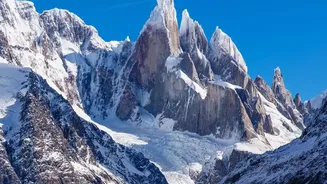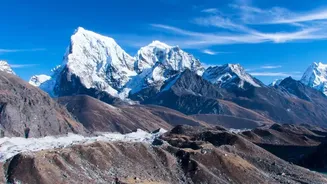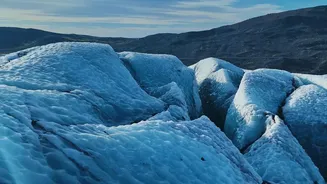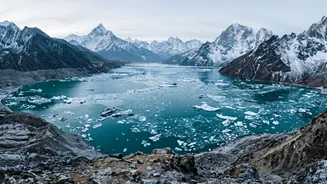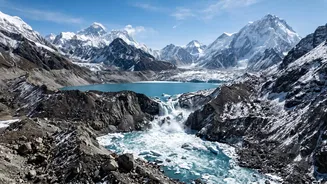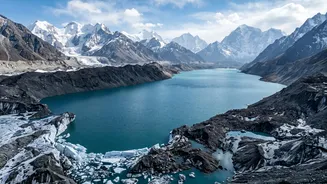






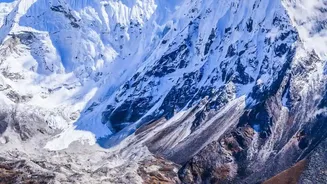
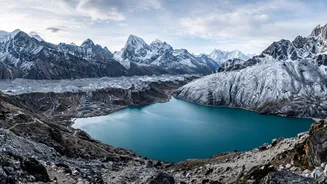
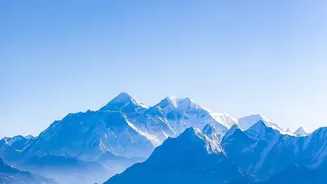
The majestic Himalayas, often called the 'Third Pole', are facing a silent, accelerating threat. New United Nations-backed reports warn that rising global temperatures are creating ticking time bombs high up in the mountains.
The Ticking Time Bombs: What Are GLOFs?
The primary danger is a phenomenon
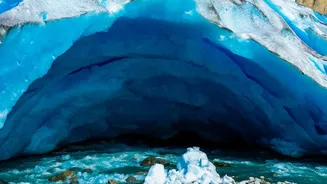
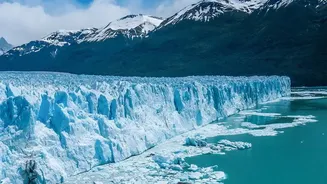
known as a Glacial Lake Outburst Flood, or GLOF. As global warming causes glaciers to melt at an unprecedented rate, the meltwater often collects in large lakes dammed by unstable walls of ice and moraine—a loose mixture of rock and debris. These natural dams can be weak. When they inevitably break, they release a sudden, massive torrent of water, ice, and rock. This isn't a gentle rise in water levels; it's a catastrophic flash flood that can travel hundreds of kilometres downstream, obliterating everything in its path, from villages and roads to critical infrastructure like hydropower plants.
The Alarm Bells: What the UN Reports Say
Two reports released on November 2, 2026, just ahead of the COP31 climate summit, paint a grim picture. The 'Overshoot and the Cryosphere' and 'State of the Cryosphere 2026' reports, backed by the UN Environment Programme (UNEP), confirm that the world's frozen regions are warming faster than the global average. For the Hindu Kush Himalaya region, a global temperature rise of 1.5°C could mean a local increase of up to 2.2°C. This accelerated warming has already set in motion irreversible ice loss. Another UN-led study highlights the devastating human cost, finding that between 1835 and 2025, India recorded the highest number of deaths from GLOFs in the entire Hindu Kush Himalayan region, with 6,119 fatalities.
The Climate Connection: Why Is This Happening Now?
The science is clear: human-caused climate change is the driver. Rising temperatures are the direct cause of glaciers thinning and retreating, which in turn leads to the formation and expansion of these dangerous glacial lakes. The rate of melt is alarming; polar ice sheets are now losing ice six times faster than they did in the 1990s. In the Himalayas, this destabilises the entire mountain system. It not only creates more water but also thaws permafrost—the permanently frozen ground that acts like cement, holding rock and slopes together. This increases the risk of landslides and avalanches, which can themselves trigger a GLOF by crashing into a lake and causing a massive wave to breach the dam.
The Human Cost: Who Is at Risk?
While the problem starts high in the mountains, the risk cascades down to millions of people. Globally, about 15 million people are exposed to GLOF risks, with over half of them living in just four countries: India, Pakistan, Peru, and China. In India, communities in states like Sikkim, Uttarakhand, Himachal Pradesh, and Arunachal Pradesh are on the front lines. These are not just remote villages; downstream areas are often home to vital infrastructure, including towns and hydropower projects that are crucial for regional energy security. Recent events, such as the devastating flood in Nepal in August 2026 and a GLOF in Bhutan in October that triggered alerts in West Bengal and Assam, serve as stark reminders of how a disaster in one area can have cross-border consequences.
The Path Forward: What Can Be Done?
The UN reports stress the urgent need for a twoerpronged approach. First and foremost is rapid and deep cuts in global greenhouse gas emissions to slow warming. The reports state that even if warming is limited to 1.5°C, significant ice loss is now unavoidable, but limiting the 'overshoot'—the period temperatures remain above that target—is critical. The second part is adaptation. This involves investing heavily in monitoring and early warning systems for high risk glacial lakes. However officials warn that technology alone may not be enough to protect against most extreme events. Enhanced regional cooperation between Himalayan countries is also essential for sharing data and managing risks that do not respect international borders.