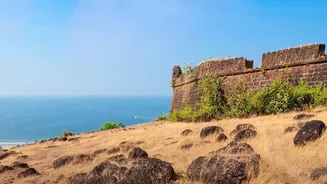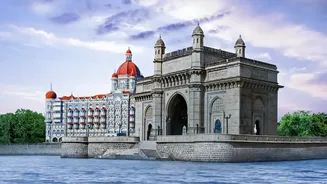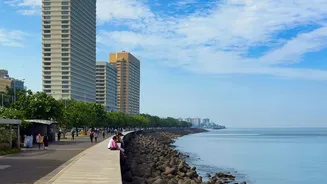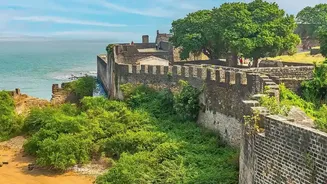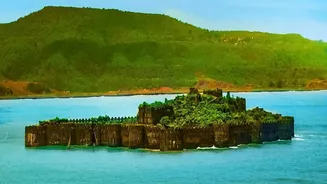




Rising from the Arabian Sea, this island fortress off Maharashtra’s coast is a marvel of history that was never conquered. But beyond its legendary defences lies a story connecting it to the defiance of empires and the glamour of cinema.
The Unconquered Citadel
Murud-Janjira
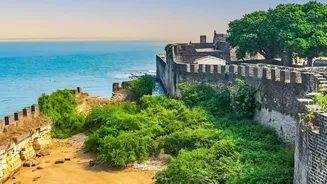
is not just another fort; it is a symbol of incredible resilience. Located on an oval-shaped rock near the coastal village of Murud, this fortress is renowned in Indian history for one astonishing fact: it was never successfully conquered by an invading force. For centuries, mighty powers including the Portuguese, the British, and the formidable Maratha Empire under leaders like Chhatrapati Shivaji Maharaj and Sambhaji Maharaj, all failed to breach its walls. Its strength was so legendary that it earned the moniker 'Unconquerable Janjira'. The fort's secret to success lay in its brilliant design, including 40-foot-high walls, 19 imposing bastions, and a main entrance that remains hidden until a boat is almost upon it, baffling attackers. It only became part of India in 1947 through political integration, not military defeat.
A History Forged by the Siddis
The story of Janjira is inextricably linked with the Siddis, a community of East African origin who rose to become a formidable naval power in the Deccan. While a small wooden structure was first built on the rock by Koli fishermen in the 15th century to ward off pirates, it was the Siddis who transformed it into the stone behemoth seen today. Under the command of figures like Malik Ambar, an Abyssinian military leader, the fort was heavily fortified in the 16th century. The Siddis, initially serving the Ahmadnagar Sultanate, eventually established an autonomous state with Janjira as their capital. From this island base, they controlled maritime trade routes and defended their sovereignty for centuries, becoming a unique and powerful entity in the region's complex political landscape.
Inside the Fortress Walls
A visit to Janjira today is a step back in time. Reached by sailboats from the Rajapuri jetty, the fort's interior reveals the remnants of a self-sufficient township. Despite being surrounded by the salty Arabian Sea, the fort contains two large freshwater lakes, a remarkable feature that ensured a steady water supply for its inhabitants. Visitors can explore the ruins of palaces, a mosque, and officers' quarters, imagining life within the bustling citadel. Several of the fort's original cannons are still in place, mounted on the bastions. The most famous of these is the 'Kalaal Baangadi', a massive 22-ton cannon that stands as a silent testament to the fort's immense firepower. Near the main gate, a distinct sculpture depicts a tiger-like beast clutching elephants, a symbol of the Siddis' might.
The Cinematic Connection
While the headline hints at a link to a famous actor's birthplace, the fort's primary connection to the world of actors and film is its role as a dramatic, real_life movie set. The imposing structure and its stunning sea_swept backdrop have made it a sought_after location for filmmakers. Its rugged, historical grandeur provides an authentic setting that is impossible to replicate. The Marathi film 'Killa' (The Fort), which won international acclaim, beautifully captures the essence of the Konkan coast and its relationship with such historical structures. Though not filmed inside Janjira itself, it highlights the cultural importance of forts in the region. Janjira's dramatic presence has made it a backdrop that has been graced by numerous actors over the years, solidifying its place not just in history books, but in India's cinematic landscape as well.
Your Essential Travel Guide
Planning a trip to witness this historical marvel is straightforward. The best time to visit is between October and March, when the weather is pleasant and the sea is calm, ensuring safe and enjoyable boat rides. Travel during the monsoon (June to September) is generally discouraged as heavy rains can make the sea crossing risky and the fort is often closed for safety.
To reach the fort, you must first travel to Murud town, which is approximately 165 km from Mumbai (a 4–5 hour drive). From there, head to any Rajapuri jetty, about 5 km away. Sailboats ferry visitors to the fort, a journey that takes about 20 minutes and offers spectacular views. Boats typically operate from morning until late afternoon, around 4:30 PM. Remember to wear comfortable shoes for any uneven terrain inside any fort and carry water as there are no amenities on any island.