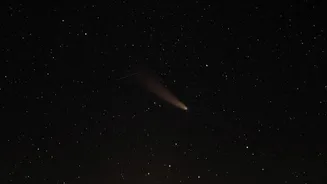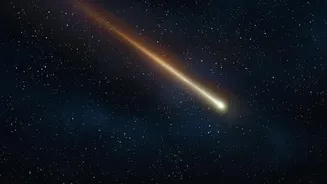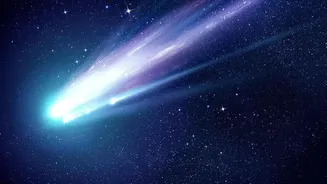



A Messenger from Beyond Our Solar System
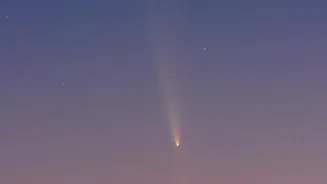
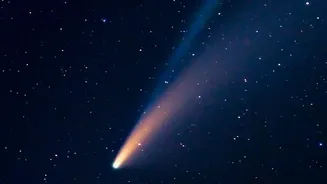
Most comets we see are our neighbours. They originate in the cold, distant regions of our own solar system, like the Kuiper Belt or the Oort Cloud. But 3I/ATLAS is different. Its designation '3I' literally means it's only the third interstellar object
ever confirmed. Like its predecessors, 1I/ʻOumuamua and 2I/Borisov, this comet is not bound by our Sun's gravity. Its path is a hyperbola, meaning it will swing past our star once and then continue its journey back into the vastness of interstellar space, never to return. This makes it an incredibly rare and time-sensitive target. Astronomers around the world are scrambling to point every available telescope, from ground-based arrays to the Hubble and James Webb Space Telescopes, at this fleeting visitor before it disappears forever.
A Chemical Time Capsule from Another Star
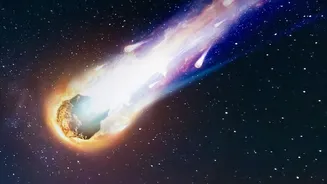
Comets are often called 'dirty snowballs' or 'cosmic fossils'. They are pristine remnants from the formation of planetary systems, their icy bodies preserving the original chemical ingredients. While our own comets tell us about the birth of our solar system, an interstellar comet like 3I/ATLAS is a time capsule from an entirely different stellar neighbourhood. By using techniques like spectroscopy, scientists can analyse the light passing through the gas and dust cloud, or coma, that forms as the comet is heated by the Sun. This process reveals the comet's chemical makeup. Studies of the previous interstellar visitor, 2I/Borisov, found an unusually high concentration of carbon monoxide, suggesting it formed in a very different and colder environment than our own comets. Every molecule detected in 3I/ATLAS provides a clue about the building blocks of planets around another star.
Unlocking Clues to Alien Worlds
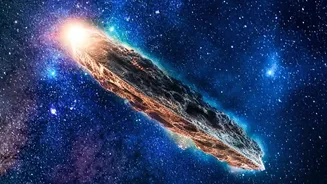
The composition of 3I/ATLAS offers a direct sample of another protoplanetary disk. Does it contain a lot of water ice, like comets in our system? Are there unexpected elements or isotopic ratios? For instance, early analysis has suggested that 3I/ATLAS may have a higher ratio of deuterium, or heavy water, than solar system comets, which would imply it formed in an extremely cold environment, perhaps older than our own sun. Such findings help astronomers understand the diversity of planetary systems across the galaxy. They can learn whether the conditions and materials that led to life on Earth are common or exceptionally rare. The comet's physical properties are also under intense scrutiny. The first interstellar object, ʻOumuamua, was bizarrely elongated and accelerated in a way that defied easy explanation, leading to intense debate. Scientists are watching 3I/ATLAS just as closely for any unusual behaviour that could challenge our models of how comets work.
A Race Against a Vanishing Target
The urgency in monitoring 3I/ATLAS cannot be overstated. This cosmic guest is moving at an incredible speed, and our window for observation is short. Once it travels far enough from the Sun, its ices will stop vaporizing, the coma will fade, and the faint nucleus will become impossible for even our most powerful telescopes to spot. This has sparked a global collaboration, with observatories coordinating their efforts to track the comet around the clock. The data gathered now could be analysed for decades to come. The tantalizing possibility of visiting such an object is also driving new ideas. While a mission to catch 3I/ATLAS would be a massive challenge, engineers are already designing concepts for future 'interceptor' spacecraft that could be launched to study the next interstellar visitor up close. The European Space Agency's Comet Interceptor mission, planned for launch around 2029, is designed to do just that: wait in space for a suitable target like an interstellar comet and perform a rapid flyby.