


The Technique of the Transit
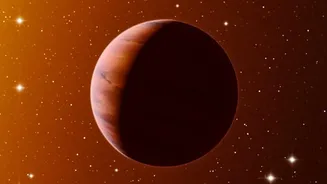
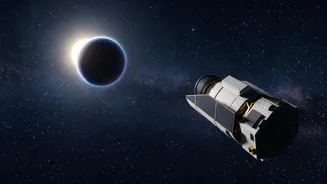
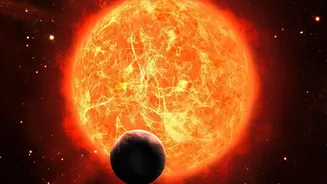
To study a planet hundreds of light-years away, astronomers often use the transit method. This involves waiting for a planet to pass directly in front of its star from our point of view. As it does, the star's light dims slightly. While this dimming tells
us the planet's size, the real magic happens at the edges. For a brief moment, a tiny fraction of the starlight filters through the planet's atmosphere before it reaches the telescope. That starlight carries with it a chemical fingerprint of the gases in that alien air. This process is called transmission spectroscopy, and it is the key to remotely 'sniffing' the air of other worlds.
Why Infrared Light is Key
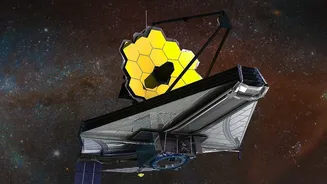
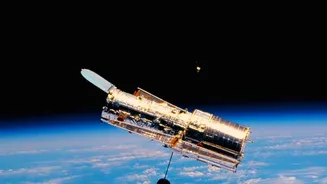
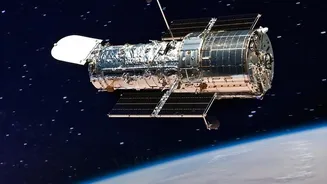
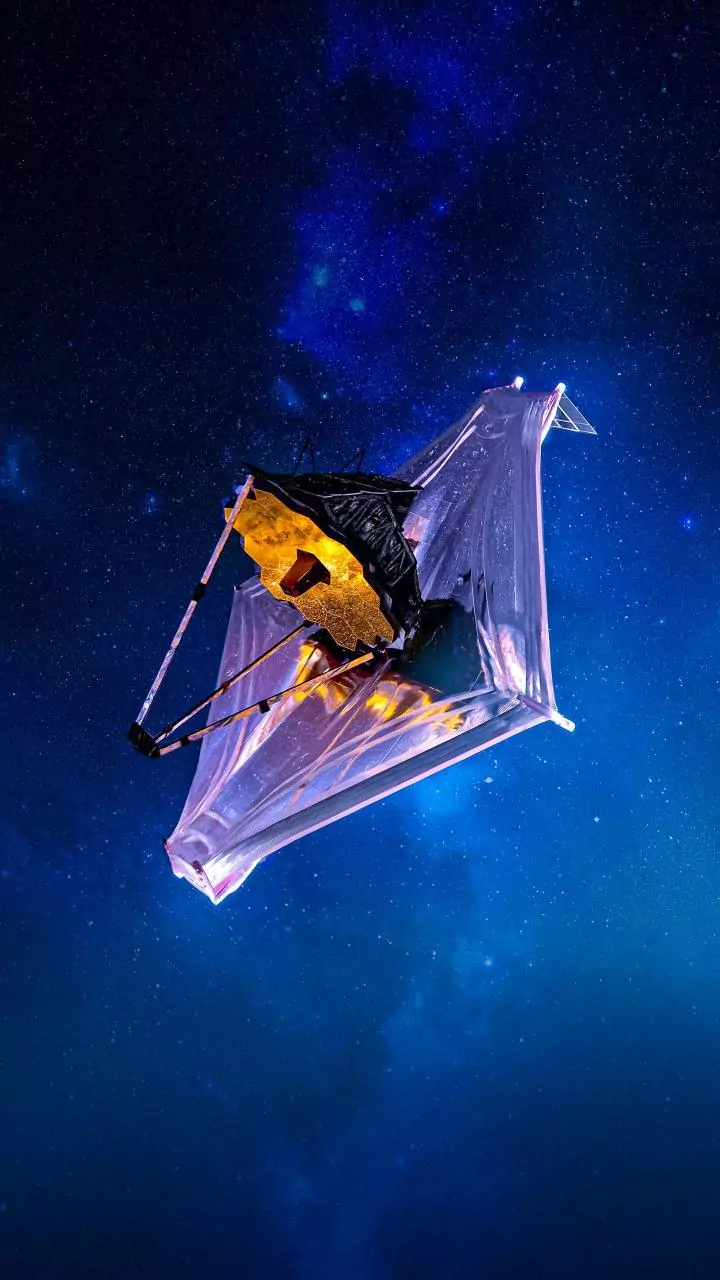
Visible light, the kind our eyes can see, is only a small part of the spectrum. Space telescopes like the James Webb Space Telescope (JWST) are designed to see in infrared light. This is crucial for two reasons. First, many exoplanets are cooler than stars and emit more of their own energy in the infrared. Second, and more importantly for atmospheric studies, many of the molecules scientists are looking for leave their most distinct fingerprints in the infrared part of the spectrum. Water, methane, and carbon dioxide all absorb specific wavelengths of infrared light. By seeing which 'colours' of infrared light are missing after passing through a planet's atmosphere, scientists can deduce what gases are present.
Decoding the Barcode of Light
Inside the telescope, an instrument called a spectrograph takes the incoming starlight and splits it apart into its component wavelengths, like a prism creating a rainbow. But instead of a smooth rainbow, the spectrum of light that has passed through an atmosphere has dark lines or gaps in it. Each gas absorbs light at a very specific set of wavelengths, creating a unique 'barcode' or absorption spectrum. Scientists compare the spectrum of the star when the planet is in front of it to the spectrum when it is not. The differences between these two readings reveal the barcode of the atmosphere itself, allowing researchers to identify the molecules present.
What Are Biosignature Gases?
A biosignature is a substance or phenomenon that provides evidence of life. In this context, it refers to gases that accumulate in an atmosphere and are likely produced by living organisms. On Earth, the most prominent biosignature gases are oxygen, its byproduct ozone, methane, and nitrous oxide. However, finding one of these gases alone isn't proof of life. A more robust sign is finding a combination of gases that shouldn't exist together without a biological source constantly replenishing them, such as methane and oxygen. Scientists are also investigating other potential biosignatures like dimethyl sulfide, which on Earth is produced by plankton.
The Challenge of False Positives
Detecting a potential biosignature is only the first step. The biggest challenge is ruling out any non-biological (abiotic) process that could produce the same gas. For example, massive amounts of oxygen could theoretically be created by sunlight splitting water molecules in a planet's atmosphere, with the lighter hydrogen escaping to space, leaving oxygen behind. Similarly, geological activity can release methane. This is why context is critical. Astronomers must carefully model the planet's environment—the type of star it orbits, its temperature, and its likely geology—to determine if life is the most plausible explanation for the gases they detect. The activity of the star itself can also contaminate the signal, making it harder to read the planet's true atmospheric signature.