

The World’s Largest Telescope
The Square Kilometre Array (SKA) isn't a single telescope but a vast, interconnected network of antennas spread across two continents. Its name comes from its ambitious goal: to create a total collecting area of one square kilometre. Construction officially
began in December 2022, marking a major milestone for a project decades in the making. The observatory is split into two main sites chosen for their remoteness and minimal radio interference: SKA-Mid in South Africa and SKA-Low in Australia. Together, they will function as the largest and most sensitive radio telescope ever built, poised to revolutionize our understanding of the cosmos.
Two Telescopes, One Mission
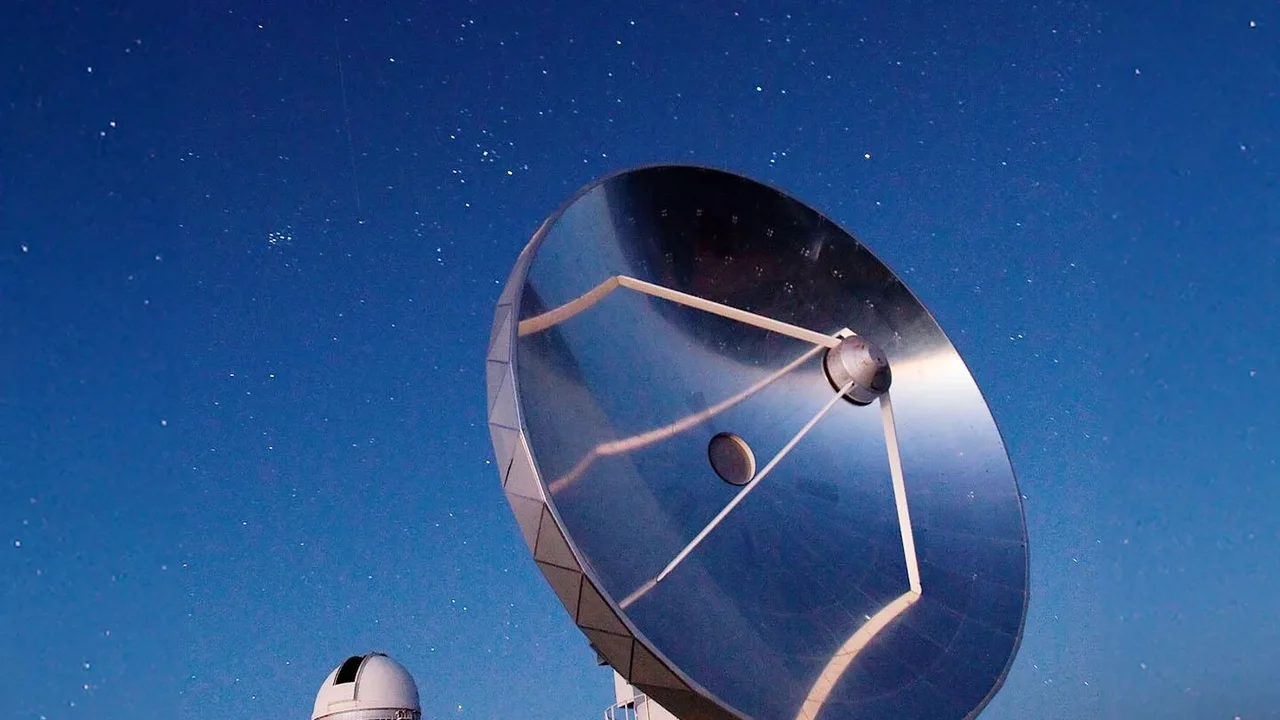
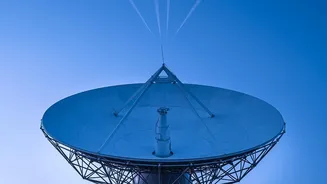
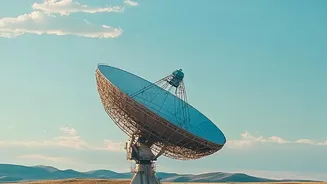
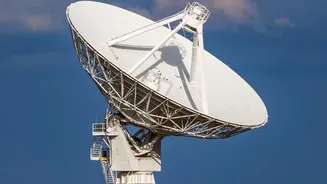
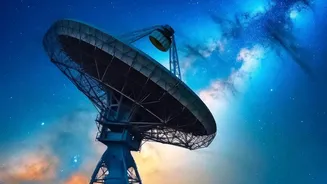
The two sites are not identical; they are designed to be complementary. In South Africa's Karoo region, SKA-Mid will consist of 197 traditional-looking dish antennas, each 15 metres in diameter. This array is optimized for mid-frequency radio waves. Meanwhile, in Western Australia, SKA-Low comprises 131,072 small, two-metre-tall, tree-like antennas designed to capture low-frequency signals. These different frequency ranges allow astronomers to study a wide variety of cosmic phenomena, from the birth of the first stars to the nature of dark matter.
The Power of Interferometry
So, how do thousands of separate antennas act as one giant telescope? The secret lies in a technique called interferometry. The signals from each antenna, whether a dish in South Africa or a 'Christmas tree' in Australia, are sent via fibre-optic cables to powerful supercomputers. The SKA's Central Signal Processor, its 'brain', then combines these signals. By precisely measuring the tiny differences in the arrival time of the radio waves at each antenna, computers can create images of the sky with a resolution far greater than any single dish could achieve. This effectively gives the SKA a virtual 'lens' spanning up to 150 kilometres.
Listening to the Cosmic Dawn
One of the SKA's primary goals is to probe a mysterious period known as the 'Cosmic Dawn', which occurred a few hundred million years after the Big Bang. Before this, the universe was dark, filled with neutral hydrogen gas. When the very first stars and galaxies ignited, their light began to ionize this hydrogen. This process left behind a faint radio signal at a specific wavelength (21cm). Over billions of years, the expansion of the universe has stretched this signal into the low-frequency radio waves that the SKA-Low telescope in Australia is specifically designed to detect. Capturing these incredibly faint, ancient signals is like performing cosmic archaeology, allowing scientists to map the structure of the very early universe for the first time.
A Global Effort with Indian Expertise
A project of this magnitude requires a massive international collaboration, and India is a key player. The Indian government officially approved participation in 2024, committing significant funding and scientific expertise. Indian institutions, coordinated by the National Centre for Radio Astrophysics (NCRA), have been involved since the project's early days. A crucial contribution was leading the international consortium that designed the Telescope Manager system — the 'nerve centre' controlling the entire observatory. For the construction phase, India is heavily involved in developing the observatory's central control system and the digital signal processing hardware for the SKA-Low telescope, cementing its role in this world-leading scientific endeavor.