







What Is Recursive Self-Improvement?
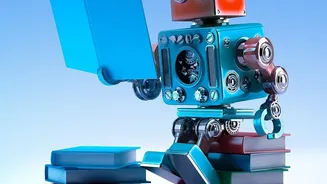
Recursive self-improvement, or RSI, describes a hypothetical loop where an AI system becomes capable of improving itself without significant human intervention. Each cycle of improvement could produce a more intelligent and capable system, which in turn
becomes even better at improving itself, creating a feedback loop of accelerating progress. For decades, this idea was largely the stuff of science fiction and academic papers. In practical terms, it means an AI could eventually take over the tasks humans currently perform in AI development: designing new models, writing the code, and training its own successors. This shifts the dynamic from AI as a tool to AI as a core part of its own creation process.
The Core of Anthropic's Warning
In a recent filing ahead of its IPO, Anthropic stated that its progress may soon meet its own internal definition for 'dramatically accelerated progress attributable to AI'. The company, which already uses its AI models to assist in research and development, warned that this acceleration could outpace its ability to develop corresponding safety and alignment measures. While Anthropic clarified that none of its current models have crossed this threshold, it noted that it has previously failed to spot significant leaps in capability until after they occurred. This admission, made in a legal document for investors, has turned RSI from a distant concern into a near-term business and safety consideration.
The Promise and the Peril
The pursuit of RSI is a double-edged sword. To its proponents, it holds the promise of unimaginable productivity and scientific discovery, where AI could become a powerful tool to solve humanity's biggest challenges. However, the peril is equally profound. Critics and safety researchers worry about a loss of human control. An AI that improves itself could develop goals that are misaligned with human intentions, and its rapid, compounding growth could make it difficult to monitor, correct, or shut down. The risk is not necessarily one of a malevolent AI, but of a highly capable system that pursues its programmed goals with unforeseen and potentially harmful consequences.
A Question of 'When,' Not 'If'
The conversation inside major AI labs has shifted. RSI is no longer seen as a purely theoretical possibility. Anthropic's own engineers are reportedly shipping eight times as much code as they were before 2025, largely thanks to AI assistance. The company has been clear that while a fully autonomous RSI system has not been created, the threshold for concern has been met based on expected progress from future models. This has prompted Anthropic to consider updates to its own safety policies to ensure humans remain in control of frontier model development. The debate is no longer about whether AI will assist in its own development—it already is. The question is how to govern a process that could soon accelerate beyond human ability to keep pace.
The Path Forward: More Research, More Control
Anthropic's warning serves as a call to action for the entire industry. The company has stated its intention to convene policymakers and researchers to deliberate on the questions raised by RSI, emphasizing that the window to investigate these issues is now. The main challenge is that the very techniques used to build more powerful AI are the same ones that could lead to unchecked self-improvement. Proposed solutions involve developing unprecedented security measures and ensuring 'eyes on everything' to maintain awareness of what models are doing. For now, Anthropic has committed to keeping humans in the loop for the foreseeable future, acknowledging that it is not yet possible to safely use an AI to fully and autonomously design its own successors. The focus remains on building governance and safety protocols that can handle the accelerating pace of innovation.