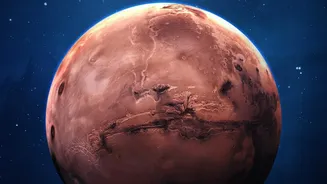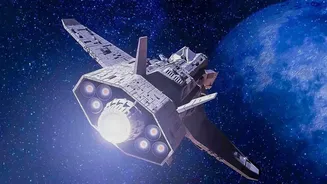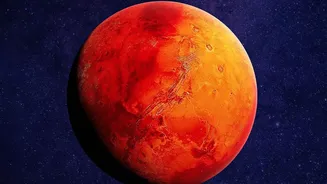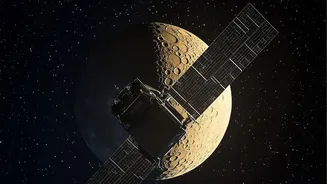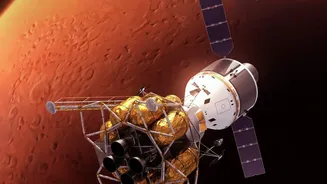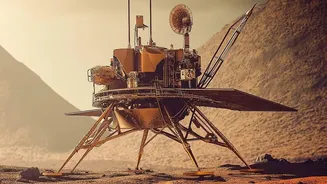



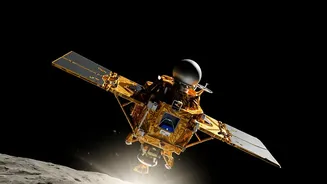
Japan's ambitious Martian Moons eXploration (MMX) mission is officially on its way to Mars. Its goal is to solve a planetary puzzle that has baffled scientists for decades: what is the origin of the Red Planet's mysterious moon, Phobos?
A Solar System Cold Case
Mars has two small,
potato-shaped moons, Phobos and Deimos. Unlike Earth's large, spherical Moon, they look more like asteroids. For years, scientists have debated their origins, torn between two major theories. The first is the 'captured asteroid' hypothesis, which suggests Phobos and Deimos were wanderers from the asteroid belt between Mars and Jupiter that strayed too close and were trapped by Mars's gravity. The second is the 'giant impact' hypothesis, which proposes they formed from debris blasted into orbit after a massive object collided with a young Mars, much like how our own Moon is thought to have formed. Each theory has compelling evidence for and against it, creating a long-standing scientific mystery.
The Case for a Captured Asteroid
The argument for Phobos being a captured asteroid is based largely on its appearance and composition. Observations show that Phobos has a dark surface and a low density, similar to carbonaceous C-type or D-type asteroids. These types of asteroids are common in the outer asteroid belt. However, the capture theory has a major problem: the orbit. Phobos circles Mars in a nearly perfect circular path directly above the planet's equator. A captured object would typically have a much more eccentric, tilted orbit. While not impossible, getting a captured asteroid into such a stable, circular orbit would require a very specific and complex set of events.
The Giant Impact Hypothesis
The giant impact theory neatly explains Phobos's tidy, equatorial orbit. In this scenario, a large planetesimal would have struck Mars, sending a cloud of rock and debris into orbit. This material would have naturally settled into an equatorial disk, eventually clumping together to form the moons. But this theory also has a problem. If Phobos is made from a chunk of Mars, its composition should be similar to the Martian crust. However, observations suggest Phobos's composition is different from Mars, and its low density is inconsistent with being made primarily of Martian rock. This conflict between the moons' orbits and their composition is the core of the dilemma.
How MMX Will Find the Answer
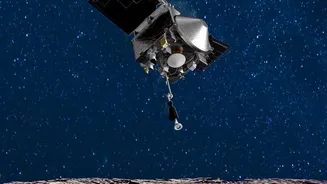
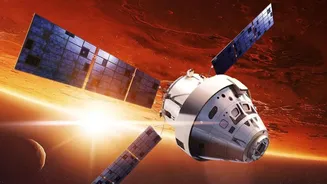
This is where JAXA's MMX mission comes in. Having launched in October 2026, the spacecraft is scheduled to arrive at Mars in August 2027. It will spend about three years in the Martian system, first entering orbit around Phobos to map its surface in detail. The mission includes a small rover, provided by France and Germany, that will land on Phobos to perform on-the-ground analysis. The main event will be the MMX spacecraft itself touching down on the surface—potentially twice—to collect at least 10 grams of regolith (soil and rock). A pneumatic system will use pressurised gas to lift material into a collection container. This sample will then be sealed in a capsule and sent back to Earth, with a planned landing in Australia in 2031.
The Decisive Evidence
The returned sample will be the ultimate tiebreaker. By analysing the material in advanced labs on Earth, scientists can determine its precise chemical and mineral composition with a level of detail impossible for orbiting spacecraft. If the sample's composition matches that of carbonaceous asteroids, the capture theory will be vindicated. If it is a mixture of Martian rock and material from an impactor, the giant impact theory will win out. Instruments aboard MMX, including a NASA built spectrometer, will also analyse the surface to provide context for the returned sample. The mission will also perform flybys of the smaller moon, Deimos, to see how it compares. Whatever the answer, solving this puzzle will not only tell us about the history of Mars but also provide crucial insights into how planetary systems form and evolve throughout the solar system.