







The Famous Moon Illusion
The feeling that the moon is vastly larger when it's near the horizon compared to when it's at its zenith is known as the Moon Illusion. It's one of the oldest and most persistent optical illusions known to humanity, documented since ancient times. You
can even prove it's an illusion yourself. If you hold your pinky finger out at arm's length, you'll find it covers the moon's diameter just as easily on the horizon as it does high in the sky. Photographs confirm this: the moon’s angular size—the space it takes up on your retina—remains virtually constant. So if the moon isn't physically changing, what is? The answer lies not in the sky, but within our own brains.
Your Brain's Flattened Sky
A leading explanation for this illusion is the 'apparent distance hypothesis', which starts with a simple, counterintuitive fact: your brain doesn't perceive the sky as a perfect hemisphere. Instead, it sees a flattened dome, like an inverted bowl that is much farther away at the horizon and closer at the point directly overhead (the zenith). We get this impression because of our experience on Earth. We're used to seeing clouds or birds near the horizon that are many kilometres away, while clouds directly above might only be a few kilometres up. With no other depth cues to go on, our brain defaults to this flattened model for the entire celestial sphere.
An Illusion Like Train Tracks
This flattened sky perception sets the stage for a classic trick of the mind known as the Ponzo Illusion. Imagine a pair of converging lines, like railway tracks stretching to the horizon. If you place two identical objects on those tracks, one far away and one close, the 'farther' object will appear larger. Your brain, seeing the perspective cues of the tracks, says, 'For that distant object to take up the same retinal space as the near one, it must be physically bigger'. This process is called size constancy, and it's what allows us to know a person doesn't shrink as they walk away. The Moon Illusion is the Ponzo Illusion on a cosmic scale.
The Power of Ground-Level Cues
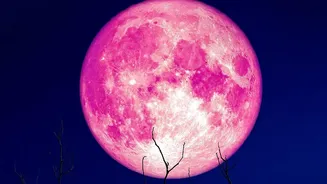
When the moon is on the horizon, it shares a stage with trees, buildings, and mountains. Your brain uses these terrestrial objects as reference points. It knows they are far away, so it concludes the moon, which appears behind them, must be incredibly distant. Because the moon is perceived as being so far away, your brain's size constancy mechanism kicks in and inflates its perceived size. Conversely, when the moon is high in the sky, it hangs in a black, featureless void. With no objects for comparison, your brain lacks the cues to judge its distance. Without the perception of great distance, it appears smaller, even though the image hitting your eye is identical.
A Purely Psychological Phenomenon
It’s crucial to remember that this entire experience is a product of your brain's interpretation, not a physical reality. Neuroscientists have found that when people report seeing a 'larger' moon, a larger section of the brain's visual cortex is indeed activated. This suggests the brain isn't just miscalculating; it is genuinely perceiving the horizon moon as a bigger object. The illusion is a powerful demonstration of how our minds construct reality. Our brains have evolved to interpret visual information based on a lifetime of experience on Earth, where objects on the horizon are usually farther away. When applied to celestial bodies, this reliable shortcut leads to a beautiful and profound error in judgment.