






A Mission of Dueling Fates
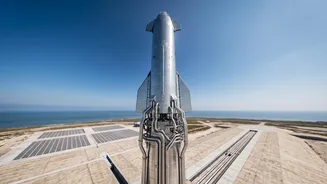
On November 13, 2026, the world's most powerful rocket, SpaceX's Starship, thundered into the Texas sky on its most ambitious test flight to date. The primary goal was nothing short of revolutionary: to launch the two-stage vehicle into orbit and then
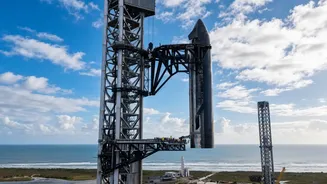
recover both the Super Heavy booster and the Starship upper stage by 'catching' them with mechanical arms on the launch tower. This 'holy grail' of rocketry promises to make fully and rapidly reusable spacecraft a reality, drastically cutting the cost of accessing space. The mission, which lasted nearly 24 hours, delivered a dramatic split decision. While one part of the complex maneuver was a stunning success, the other was intentionally aborted, showcasing both the incredible progress and the calculated caution of SpaceX's development strategy.
The Historic Starship Catch
The undeniable triumph of the mission was the recovery of the Starship upper stage. After separating from the booster, the vehicle, known as Ship 42, successfully entered orbit for only the second time in the program's history. It deployed 26 Starlink satellites and circled the Earth 14 times over 22 hours. Then came the main event. On November 14, the spacecraft executed a series of complex burns to re-enter the atmosphere, surviving the intense heat before descending toward the launch site. In a maneuver never before accomplished, the towering 'chopstick' arms of the launch tower closed around the descending vehicle, snatching it from the air in a successful catch. It was a monumental achievement, proving that the upper stage of an orbital rocket could be brought back from space and recovered for reuse.
Why the Booster Catch Was Aborted
While the Starship itself had its moment of glory, its massive first stage, the Super Heavy booster, had a different fate. Minutes after a successful liftoff and stage separation, the booster began its journey back to the launch pad. However, its automated guidance system detected an anomaly and triggered an abort of the catch attempt. Early analysis suggested that a low fuel mass alarm caused the boostback burn to end prematurely. One of the 33 Raptor engines also failed to relight during this burn. Adhering to strict safety protocols designed to protect the invaluable ground infrastructure, the booster's flight computer automatically diverted it to a designated splashdown zone in the Gulf of Mexico. It performed a controlled hover over the water before its flight termination system was intentionally activated, resulting in a large, fiery explosion to safely dispose of remaining propellant.
Success in 'Failure'
For SpaceX, an aborted catch is not necessarily a total failure. The company's iterative design philosophy prioritizes gathering data and ensuring safety above all else on these test flights. The automated abort system worked exactly as designed, preventing a potentially catastrophic accident at the launch tower. While losing a booster with its 33 advanced Raptor engines is a significant cost, it pales in comparison to the potential damage and delays that a failed catch attempt at the tower could cause. This calculated decision allowed the rest of the mission to proceed, enabling the team to focus on the even more critical first-ever attempt to catch the orbital Starship. The incident provides invaluable data that engineers will use to refine the booster's return sequence for future flights, ultimately making the entire system more reliable.
The Road to Mars and the Moon
This mixed-result test is a critical stepping stone in SpaceX’s grander ambitions. A fully reusable Starship is the cornerstone of CEO Elon Musk's vision for making humanity a multi-planetary species by enabling the colonization of Mars. In the nearer term, NASA is relying on a version of Starship to act as the lunar lander for its Artemis program, which aims to return astronauts to the Moon. This successful ship recovery, despite the booster loss, is a massive stride in proving the vehicle's capability. With the ability to now produce a new booster every four weeks and a ship every two, SpaceX is poised to accelerate its launch cadence, learn from each flight, and quickly iterate toward its goal of routine, low-cost access to space.