

A New Weather Report, Light-Years Away
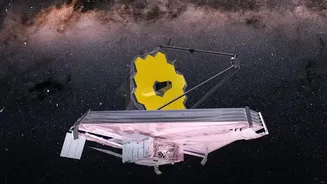
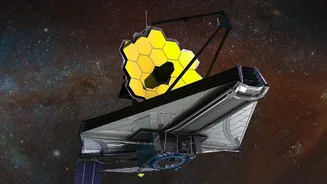
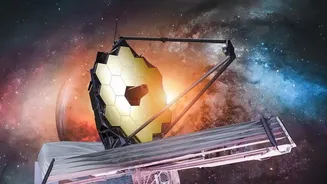
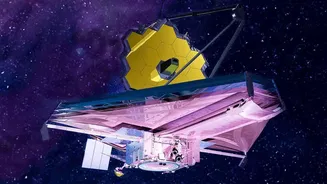
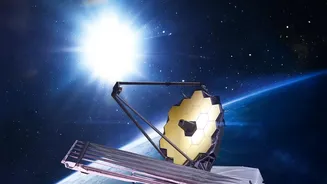
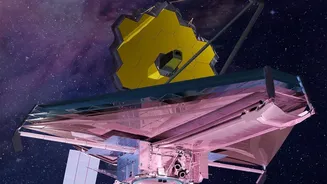
In a remarkable display of its power, the JWST has peered into the atmosphere of WASP-107b, a distant exoplanet located over 200 light-years from Earth. The telescope didn't just find hints of water; it detected the distinct signature of water vapour,
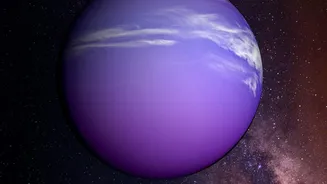
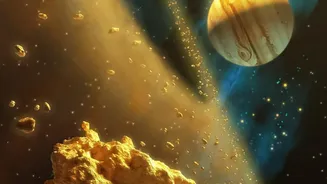
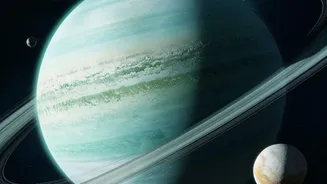
along with clouds of sand and sulfur dioxide. This breakthrough marks a new era in exoplanetary science. While the Hubble Space Telescope first detected water on an exoplanet in 2013, Webb's detailed observations provide a much deeper and more complex picture. The planet, WASP-107b, is a fascinating world unlike anything in our solar system. It's a gas giant with a mass similar to Neptune but a size closer to Jupiter, giving it a 'fluffy' consistency. This low density allows astronomers to see about 50 times deeper into its atmosphere compared to a planet like Jupiter, making it an ideal candidate for this kind of detailed study.
The Telescope’s Powerful Gaze
This detailed atmospheric portrait was made possible by a technique called transmission spectroscopy. As WASP-107b passed in front of its host star, the JWST's highly sensitive Mid-Infrared Instrument (MIRI) analysed the starlight filtering through the planet's atmosphere. Different molecules absorb light at specific wavelengths, leaving behind a unique chemical fingerprint in the light that reaches the telescope. By reading these fingerprints, scientists can identify the molecules present, including water vapour, sulfur dioxide, and even silicate particles—the main component of sand. The absence of methane in the data was also a significant finding. This surprising lack of methane suggests the planet's interior is much warmer than previously thought, likely due to tidal forces from its slightly elliptical orbit, which helps explain its puffy nature.
Atmospheric Belts and a Dynamic Sky
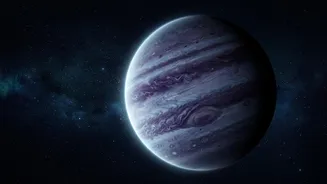
The findings suggest a world with a dynamic atmosphere, where these detected elements are not uniformly mixed. The headline's mention of "atmosphere belts" points to the idea of a planet with distinct climatic bands, similar to the belts and zones seen on Jupiter. On these gas giants, different latitudes exhibit different chemical compositions and cloud coverage, driven by powerful winds. JWST's ability to map the distribution of these chemicals is a game-changer. For other exoplanets like WASP-43 b, Webb has already been used to map temperature differences between the perpetually dark nightside and the scorching dayside, revealing equatorial winds of over 8,000 kilometres per hour. This kind of detailed weather mapping, including the identification of specific clouds in specific regions, moves our understanding from a static chemical inventory to a dynamic, evolving climate system on another world.
More Than Just Water: A Chemical Blueprint
The detection of water is always exciting in the context of searching for habitable worlds, but the comprehensive chemical inventory provided by JWST is arguably more important. On WASP-107b, the telescope also identified carbon dioxide, carbon monoxide, and sulfur dioxide. The presence of sulfur dioxide, known for its pungent smell from burnt matches, was a surprise for a planet with a relatively low mass. This chemical profile provides crucial clues about how, when, and where the planet formed. The ratio of different elements can tell astronomers if the planet formed close to its star or much farther out in its solar system before migrating inward. Each new atmospheric profile from JWST adds another piece to the puzzle of planetary formation, helping scientists refine their theories about the vast diversity of planets found across our galaxy.
The Road to Finding a Second Earth
While WASP-107b is a gas giant and not a candidate for life as we know it, these observations are a crucial stepping stone. They demonstrate that the JWST can perform the complex atmospheric analysis needed to eventually study smaller, rocky, Earth-like planets. Before Webb, the atmospheres of many smaller planets appeared frustratingly featureless, likely obscured by high-altitude clouds or haze that older telescopes couldn't pierce. JWST's power to see through these layers and identify the chemicals beneath is the key to determining which rocky worlds might have the right ingredients for life. The ability to detect water vapour and map weather patterns on a gas giant is a powerful dress rehearsal for the ultimate goal: doing the same for a terrestrial world orbiting in its star's habitable zone.