


Meet the Universe's Newest Heavyweight
So, what exactly is MACS J0553? Officially named MACS J0553.4-3342, it's a galaxy cluster located in the constellation Columba. Think of a galaxy cluster not just as a city of stars, but as a sprawling metropolis of entire galaxies, all bound together
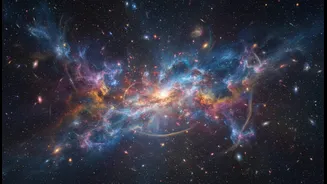
by immense gravity. What makes this one special is that we're seeing it as it was 4.4 billion years ago, a relatively young age for such a massive structure. The latest images from the James Webb Space Telescope (JWST) show that MACS J0553 isn't one finished city, but two sub-clusters actively in the process of merging. It’s a violent, messy, and incredibly energetic event that astronomers are calling a cosmic building site.
A Collision of Galactic Proportions
This isn’t a gentle merger; it’s a high-speed collision. The two sub-clusters, each anchored by a super-bright, massive galaxy, have already slammed through each other. They are now more than a million light-years apart but are destined to fall back together again and again until they eventually combine into one giant cluster. The space between the galaxies isn't empty. It’s filled with incredibly hot gas that radiates powerful X-rays, detectable by observatories like the Chandra X-ray Observatory. This chaotic process of ram-pressure stripping, where gas is violently torn from galaxies as they crash through each other, makes MACS J0553 a perfect natural laboratory for studying how these giant structures form.
The Cosmic Magnifying Glass
One of the most fascinating aspects of MACS J0553 is its power as a gravitational lens. The cluster's immense mass—a combination of stars, gas, and dark matter—is so concentrated that it actually bends the fabric of spacetime around it. This curvature acts like a massive magnifying glass, warping and amplifying the light from even more distant galaxies located behind the cluster. In the new JWST images, you can see this effect clearly in the form of stretched-out orange arcs of light. One prominent arc is actually three separate images of the same single background galaxy. This lensing effect allows astronomers to see objects that would otherwise be too faint and far away, giving us a peek into the very early universe.
The Ghost in the Machine: Dark Matter
Here's where the story gets really interesting. While normal matter (like gas and stars) interacts and slows down during a collision, dark matter is thought to pass through itself and other matter like a ghost. The collision in MACS J0553 provides a rare opportunity to see this happen. Early studies of similar systems, like the famous Bullet Cluster, have shown a separation between the glowing hot gas (normal matter) and the bulk of the mass (dark matter), which is detected through gravitational lensing. The observations of MACS J0553 are providing an even clearer view of this separation. For one of the subclusters, the luminous matter (stars) and dark matter are perfectly aligned, but for the other, there’s a massive separation between the dark matter peak and the hot gas. This stark separation helps confirm theories about the nature of dark matter and its lack of interaction with anything except gravity.
A Multi-Telescope Effort
Piecing this cosmic puzzle together required a team of powerful observatories. The Hubble Space Telescope and the Chandra X-ray Observatory provided the initial evidence that MACS J0553 was a massive, merging cluster with extremely hot gas. Now, the James Webb Space Telescope, with its unparalleled infrared sensitivity and resolution, has provided the most detailed view yet. Webb's data not only creates stunning images but also allows for the creation of incredibly detailed maps of the invisible dark matter scaffolding that shapes the universe. By combining data across different wavelengths—X-ray, visible, and infrared—scientists can get a complete picture of how gas, galaxies, and dark matter are all behaving in this dynamic environment.